APOD Science APOD APOD: 2026 November 25 –… Today’s APOD Archive Submissions Index Search Calendar RSS Education About Discuss APOD Astronomy Picture of the Day Discover the cosmos! Each day a different image or photograph of our fascinating universe is featured, along with a brief explanation written by a professional astronomer.
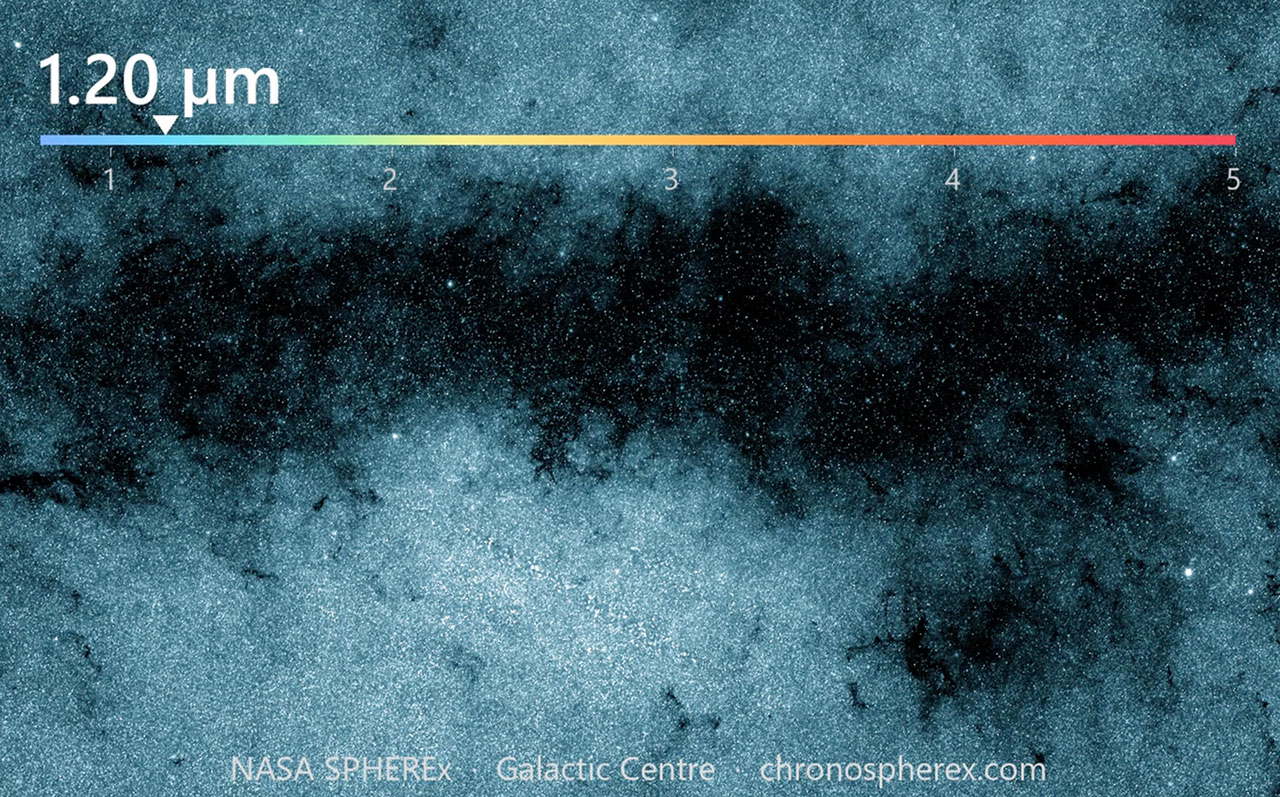
To view this video please enable JavaScript, and consider upgrading to a web browser that supports HTML5 video Credit: NASA/JPL-Caltech SPHEREx; data from NASA/IPAC IRSA. Processing: The Bright Nobles (Muhammet Mücahit Soylu, Serdar Aydın, Furkan Küpeli), ChronosphereX (chronospherex.com).
SPHEREx Seeing Through Dust Explanation: What is blocking the center of the Milky Way? During its 13 billion years , our Milky Way has collected a lot of dust.
To view this video please enable JavaScript, and consider upgrading to a web browser that supports HTML5 video Credit: NASA/JPL-Caltech SPHEREx; data from NASA/IPAC IRSA. Processing: The Bright Nobles (Muhammet Mücahit Soylu, Serdar Aydın, Furkan Küpeli), ChronosphereX (chronospherex.com). SPHEREx Seeing Through Dust Explanation: What is blocking the center of the Milky Way?
During its 13 billion years , our Milky Way has collected a lot of dust. In contrast to the skin cells, dirt, pollen, and other debris that make up the dust behind your couch, cosmic dust is hundreds of times smaller and made of tiny compounds of oxygen, carbon, and other elements released into space when a star dies .
Today’s video shows infrared light from the Milky Way’s center gathered by NASA’s SPHEREx satellite. Each false color in the video corresponds to the infrared color associated with the wavelength shown in the top left. In the near-infrared, like 1.2 microns , light gets absorbed and scatters off of dust particles.
SPHEREx then sees the Galactic Center almost entirely blocked by clouds of dust . In the mid-infrared, though, light is able to pierce through the dust and reach SPHEREx. This is similar to, but not exactly, why sunsets are red ! Tomorrow’s picture: a sandy view of the Milky Way Date: November 25, 2026 Credit: Credit: NASA/JPL-Caltech SPHEREx; data from NASA/IPAC IRSA.