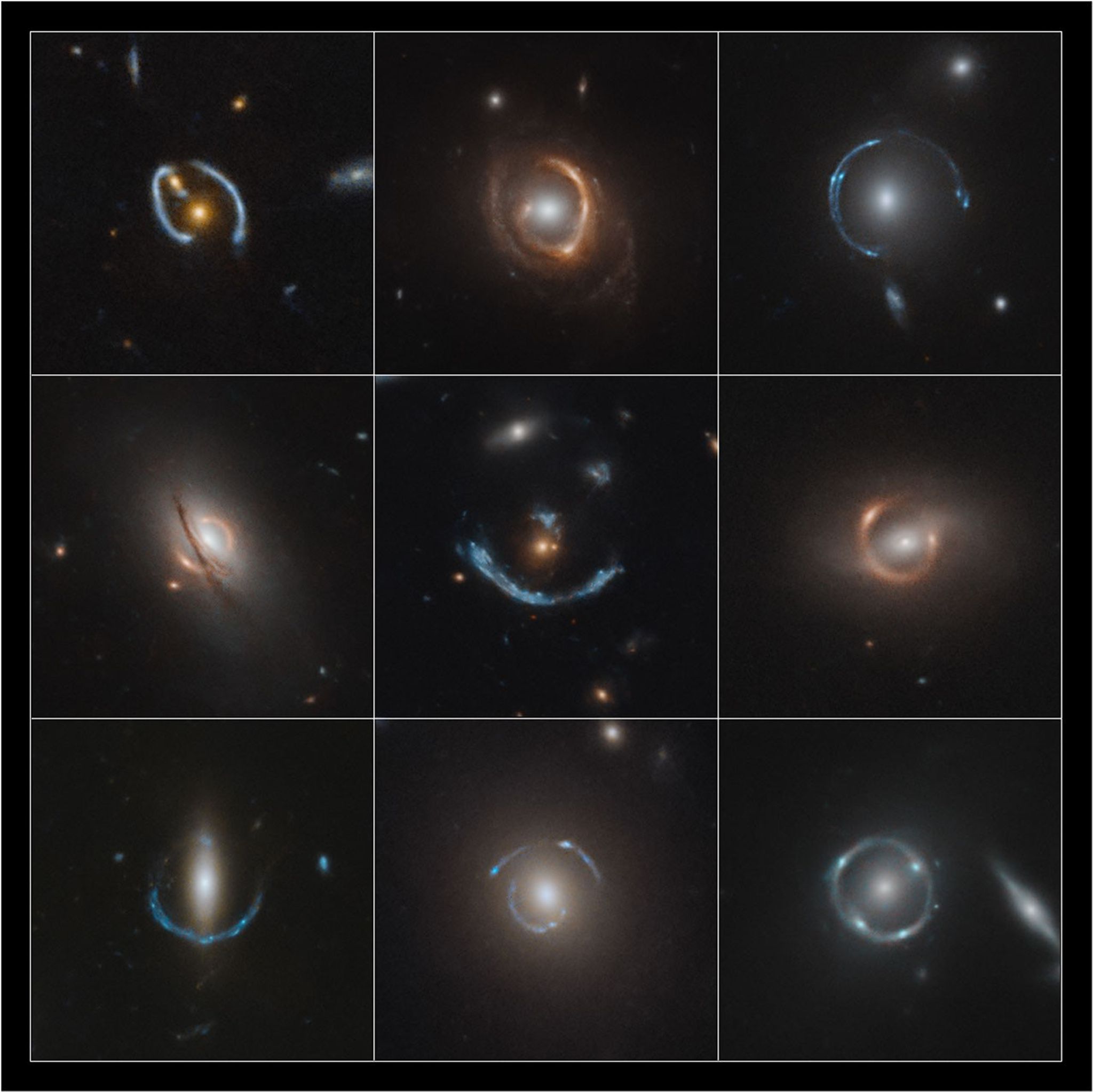
NASA's Hubble Space Telescope has captured a diverse range of strong gravitational lenses, which will be used as targets for follow-up observations by the Nancy Grace Roman Space Telescope. Gravitational lensing occurs when the gravity of a massive foreground object bends and magnifies the light from a more distant background object, allowing astronomers to view objects that would otherwise be too far away.
The Hubble images showcase a variety of lensing effects, including arcs, rings, and quadruply lensed galaxies, which will be used to construct lens models and study the distribution of mass in the foreground galaxies. Astronomers will use these observations to investigate the evolution of galaxies and dark matter, by studying the amount of distortion of the lensed background galaxies.
The Hubble telescope views the cosmos in visible and ultraviolet light, providing a high-resolution view of individual objects, while the Roman Space Telescope sees primarily infrared light and will capture a larger field of view. The combination of Hubble's high-resolution imaging and Roman's wider field of view will allow researchers to detect small imperfections in the gravitationally lensed galaxy arcs, which could indicate the presence of small clumps of dark matter.
The unique lenses captured by Hubble display different characteristics, such as arc-counterarc configurations, Einstein Rings, and quadruply lensed galaxies. These diverse lenses will be used to test models and study the properties of dark matter, with the goal of confirming or dispelling the cold dark matter theory.