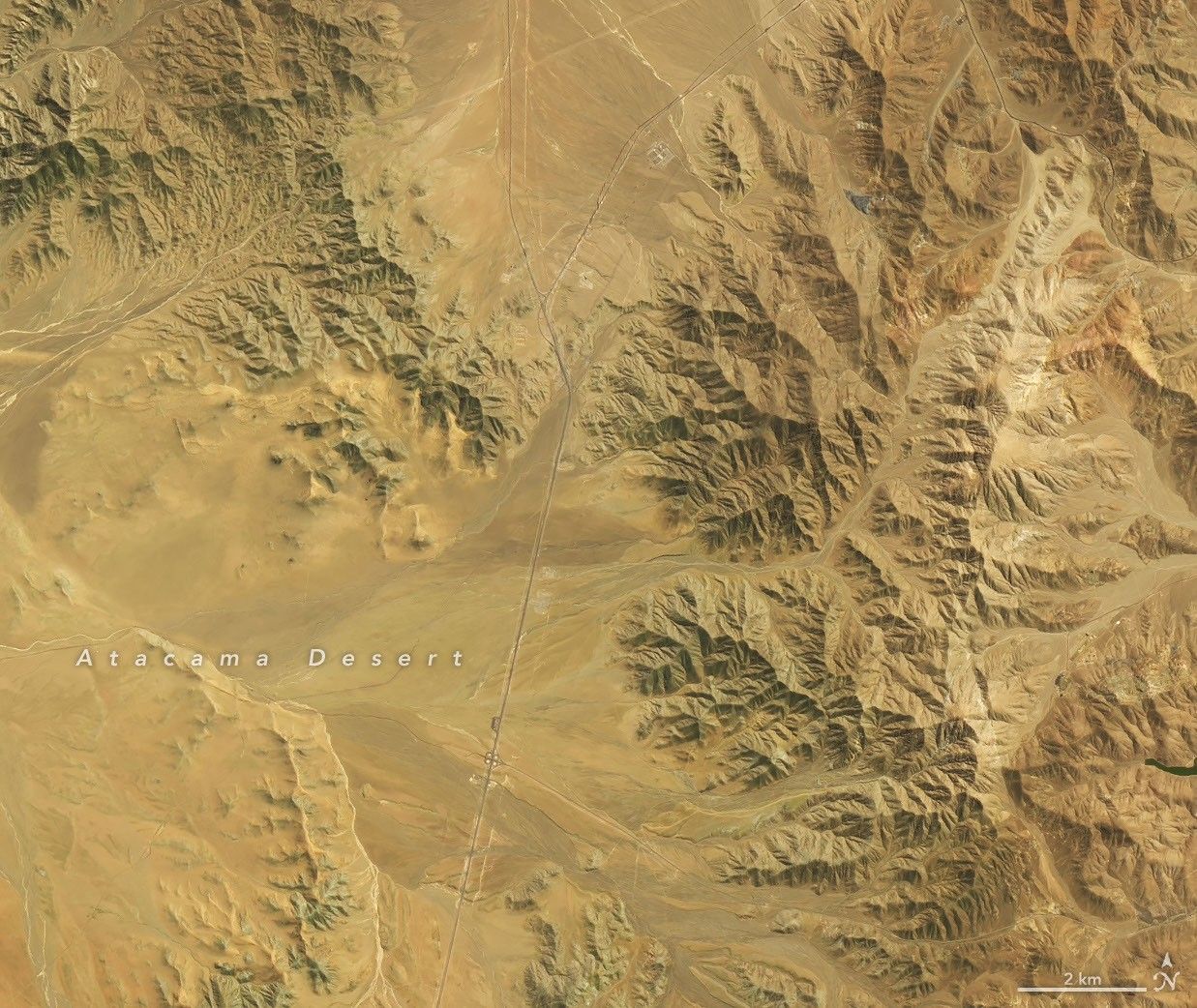
Earth Observatory Science Earth Observatory El Niño Rains Paint the Atacama Earth Earth Observatory Image of the Day EO Explorer Topics All Topics Atmosphere Land Heat & Radiation Life on Earth Human Dimensions Natural Events Oceans Remote Sensing Technology Snow & Ice Water More Content Collections Global Maps World of Change Articles Earth Matters Blog Blue Marble: Next Generation EO Kids Mission: Biomes About About Us Subscribe 🛜 RSS Contact Us Search September 14 October 24 NASA Earth Observatory/Michala Garrison NASA Earth Observatory/Michala Garrison September 14 October 24 NASA Earth Observatory/Michala Garrison NASA Earth Observatory/Michala Garrison September 14 October 24 Curtain Toggle 2-Up Parts of the Atacama Desert in northern Chile, normally one of the driest places on Earth, turned red-purple, green, and white in austral spring 2026 following an unusually wet winter.
The rain woke seeds lying dormant in the soil, setting off what scientists say may be the most extensive desierto florido , or “flowering desert,” of the satellite era. The rains came as El Niño was strengthening in the tropical Pacific.
During an El Niño, the subtropical Pacific high that normally keeps the region dry weakens, while a blocking high tends to form in the South Pacific near the tip of South America. Together, these shifts push the Southern Hemisphere storm track equatorward.
Beginning in mid-July, a series of storm fronts fed by an atmospheric river brought one of the heaviest July rain events in decades to a long stretch of Chile, from the Atacama region south to Los Lagos, according to Chile’s national weather service (Dirección Meteorológica de Chile). In August, back-to-back winter storms blanketed parts of the Atacama Desert in rare snow .