Earth Observatory Science Earth Observatory Seeking Refuge on Resolution… Earth Earth Observatory Image of the Day EO Explorer Topics All Topics Atmosphere Land Heat & Radiation Life on Earth Human Dimensions Natural Events Oceans Remote Sensing Technology Snow & Ice Water More Content Collections Global Maps World of Change Articles Earth Matters Blog Blue Marble: Next Generation EO Kids Mission: Biomes About About Us Subscribe 🛜 RSS Contact Us Search In the late 1800s, wildlife conservationists in New Zealand were recognizing how predators such as stoats , brought to the country to control other nonnative animal populations, were becoming a threat to native birds.
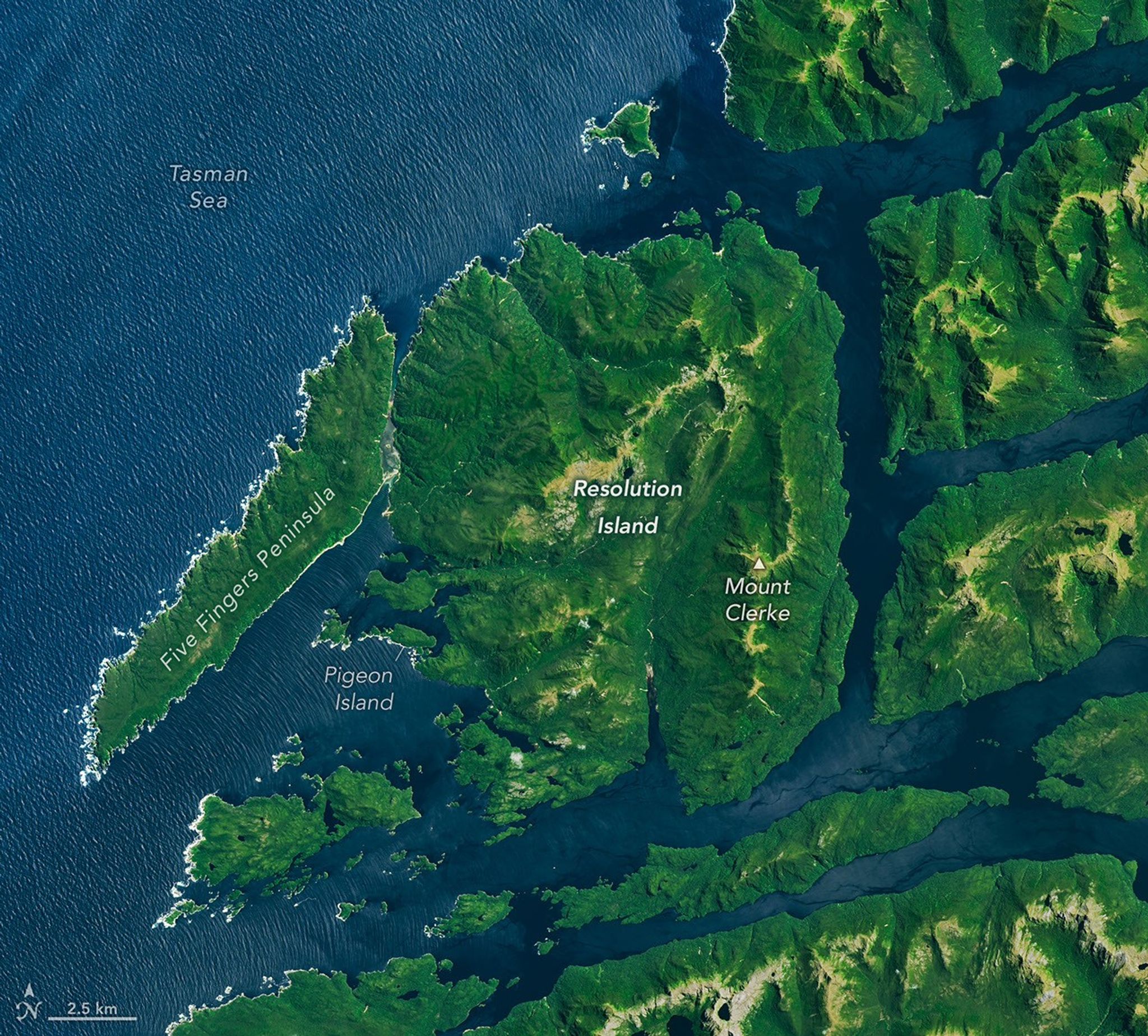
Naturalists at the time surmised that some of the nation’s islands could serve as sanctuaries where endemic species could persist, free from the voracious newcomers. Resolution Island, located in the Fiordland region along the rugged southwest edge of New Zealand’s South Island, was one of the first eyed for this purpose.
Naturalists at the time surmised that some of the nation’s islands could serve as sanctuaries where endemic species could persist, free from the voracious newcomers. Resolution Island, located in the Fiordland region along the rugged southwest edge of New Zealand’s South Island, was one of the first eyed for this purpose.
Conservationist Thomas Henry Potts proposed in 1872 that the island could be a place where “wingless species, and birds of feeble powers of flight, might there find a refuge for some of their representatives.” So began an early systematic effort to protect kiwi, kākāpō , and other native birds on Resolution Island, the largest of the approximately 90 islands in Fiordland National Park .
This image, acquired with the OLI (Operational Land Imager) on Landsat 9 on December 12, 2025, shows the island’s setting amid a landscape of steep-sided valleys carved by glaciers and now inundated by the ocean. The uninhabited island rises from sea level to the summit of Mount Clerke at 1,069 meters (3,507 feet).