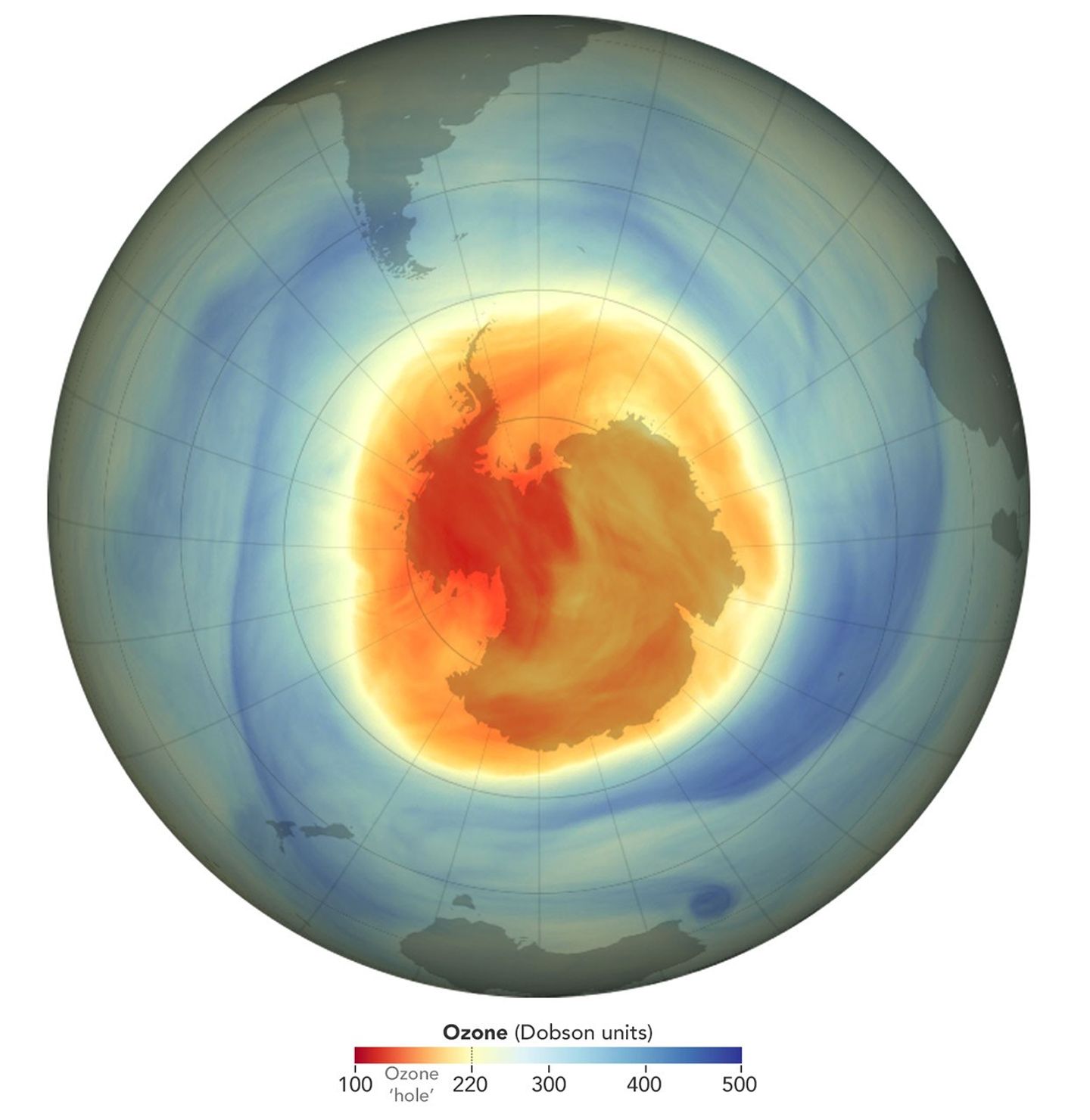
Earth Observatory Science Earth Observatory Ozone Hole Reaches Its 2026… Earth Earth Observatory Image of the Day EO Explorer Topics All Topics Atmosphere Land Heat & Radiation Life on Earth Human Dimensions Natural Events Oceans Remote Sensing Technology Snow & Ice Water More Content Collections Global Maps World of Change Articles Earth Matters Blog Blue Marble: Next Generation EO Kids Mission: Biomes About About Us Subscribe 🛜 RSS Contact Us Search This data visualization shows the area and shape of the ozone hole on September 18, 2026, the day of its annual maximum extent.
Scientists define the ozone hole as the area in which ozone concentrations drop below the historical threshold of 220 Dobson units. NASA Earth Observatory/Lauren Dauphin This story is an update to the Antarctic ozone hole feature in our World of Change series , which documents how Earth changes over months, seasons, and years.
Scientists define the ozone hole as the area in which ozone concentrations drop below the historical threshold of 220 Dobson units. NASA Earth Observatory/Lauren Dauphin This story is an update to the Antarctic ozone hole feature in our World of Change series , which documents how Earth changes over months, seasons, and years.
The stratospheric ozone layer protects life on Earth by absorbing ultraviolet light, which damages DNA in plants and animals (including humans) and leads to sunburns and skin cancer. Prior to 1979, scientists had not observed atmospheric ozone concentrations below 220 Dobson Units .
But in 1985, British Antarctic Survey scientists using ground-based measurements at Halley Research Station reported that Earth’s natural sunscreen was thinning dramatically over Antarctica each spring. NASA satellite instruments revealed the continental scale of this Antarctic ozone thinning, and it came to be known as the ozone hole.
The data visualizations below shows the ozone hole each year from 1979 through 2026 (no data are available for 1995).