Earth Observatory Science Earth Observatory Tossing Fireworks from Cloud… Earth Earth Observatory Image of the Day EO Explorer Topics All Topics Atmosphere Land Heat & Radiation Life on Earth Human Dimensions Natural Events Oceans Remote Sensing Technology Snow & Ice Water More Content Collections Global Maps World of Change Articles Earth Matters Blog Blue Marble: Next Generation EO Kids Mission: Biomes About About Us Subscribe 🛜 RSS Contact Us Search October 28, 2026 For astronauts on the International Space Station , looking back to Earth at night can be as dazzling as looking outward toward the stars.
In an essay for Air & Space magazine, Donald Pettit, a NASA astronaut and dedicated photographer , described the “spectacular” view of Earth at night visible from the station. Cities and civilization, he wrote, looked “like tendrils outlined with the glimmer of a Broadway marquee.”
In an essay for Air & Space magazine, Donald Pettit, a NASA astronaut and dedicated photographer , described the “spectacular” view of Earth at night visible from the station.
Cities and civilization, he wrote, looked “like tendrils outlined with the glimmer of a Broadway marquee.” Intense, colorful lights cast by clusters of fishing boats across darkened oceans reminded him of “a constellation of stars” forming “unfamiliar members of the Zodiac.” NASA astronaut Sally Ride —the first American woman to fly in space—also marveled at the “indescribable” sights of Earth from orbit.
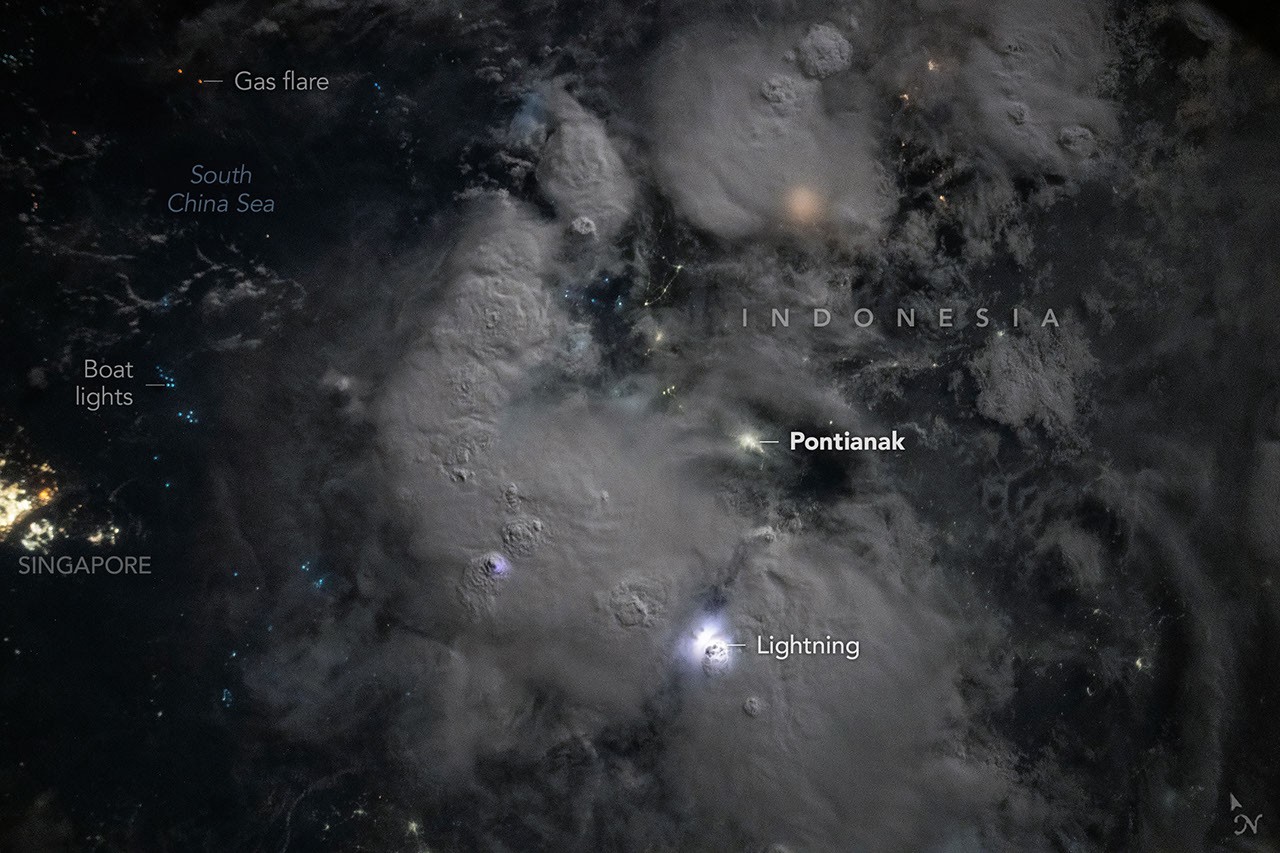
Lightning was among the most spectacular, she noted in an essay for the same magazine . “On Earth, people see lightning from below the clouds. In orbit, we see it from above,” she wrote. “Bolts of lightning are diffused by the clouds into bursting balls of light.
Sometimes, when a storm extends hundreds of miles, it looks like a transcontinental brigade is tossing fireworks from cloud to cloud.” All three phenomena—city lights, fishing fleets, and lightning—were on display when the space station passed over the South China Sea near Borneo at 14:20 UTC (9:20 p.m. Western Indonesian Time) on October 28, 2026.