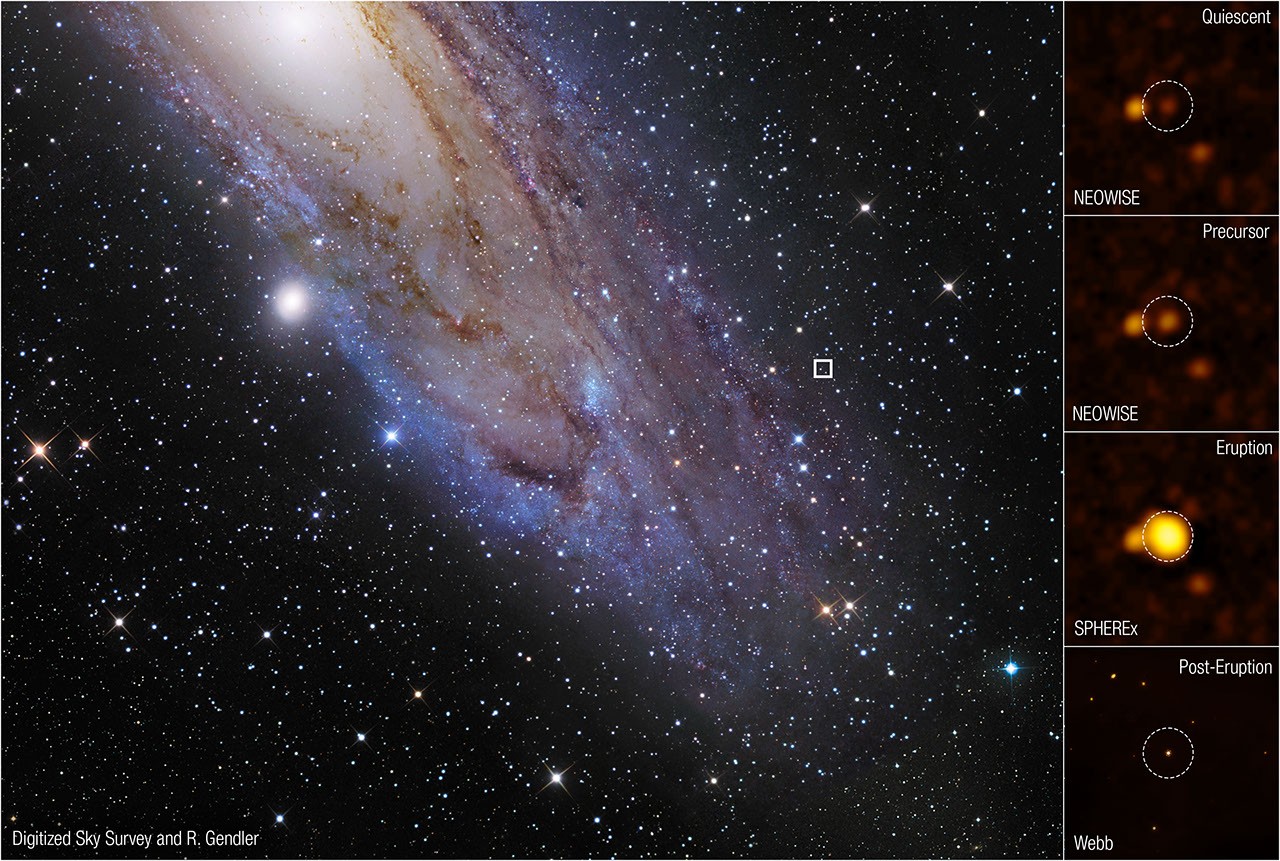
The system consisted of a star slightly less massive than the Sun and a puffy supergiant star, which spiraled into and merged with each other. Researchers, led by Viraj Karambelkar, a NASA Hubble Fellow at Columbia University, monitored the system and noticed an unusual eruption in 2025.
The James Webb Space Telescope observed Bao just 47 days after the eruption peaked, allowing researchers to characterize the system before, during, and after the merger. This is the earliest follow-up of an event like this, providing valuable insights into the merger process.
The merger occurred after only seven orbits, which is much faster than other known binary star mergers. The researchers used simulations to reconstruct the events leading up to the merger and found that the primary star was seven times as massive as the Sun, with a radius 350 times larger and a brightness 18,000 times greater.
The team also estimated the mass of the smaller, demolished companion star, which was found to be slightly less massive than the Sun.