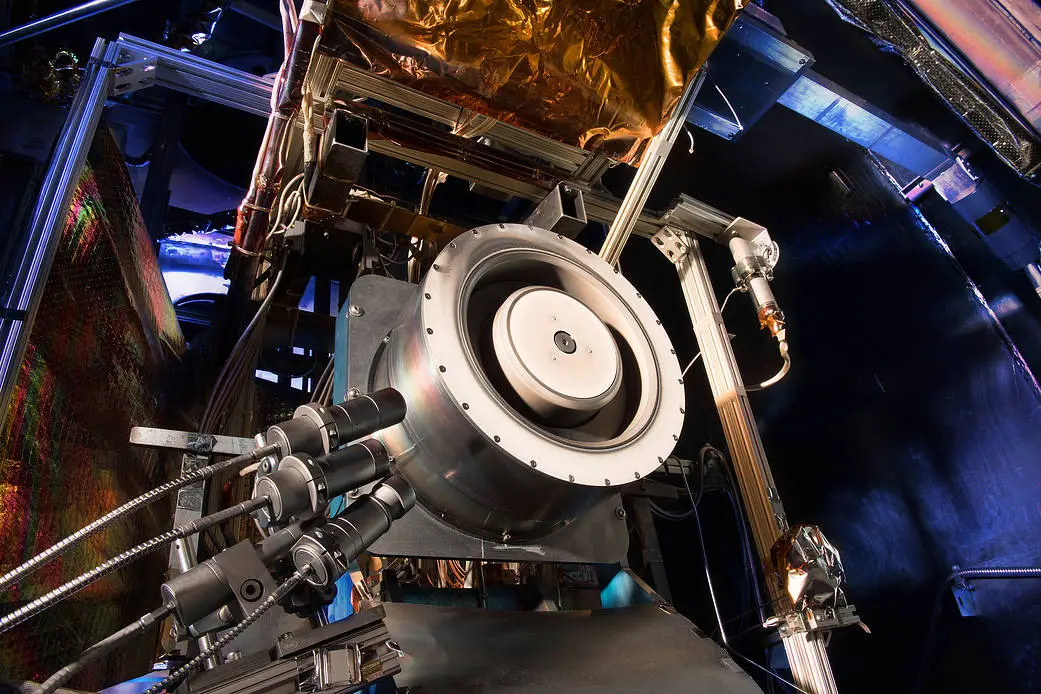
2 min read Preparations for Next Moonwalk Simulations Underway (and Underwater) The Hall thruster is part of an Solar Electric Propulsion (SEP) system that uses 10 times less propellant than equivalent chemical rockets. Image Credit: NASA/Michelle M.
Murphy (Wyle Information Systems, LLC) NASA launched a new competition inviting U.S. companies to produce prototypes of mid-power Hall effect thrusters – a type of electric propulsion system considered crucial for future space operations and exploration.
Hall effect thrusters use an electric field to accelerate a propellant gas, producing efficient thrust for long-duration missions. Used for propelling satellites and deep space robotic vehicles, Hall effect thruster systems are critical for space operations and exploration.
NASA’s Advanced Mid-Power Electric Rocket (AMPERE) Challenge is offering $500,000, split between two winning U.S.
Murphy (Wyle Information Systems, LLC) NASA launched a new competition inviting U.S. companies to produce prototypes of mid-power Hall effect thrusters – a type of electric propulsion system considered crucial for future space operations and exploration.
Hall effect thrusters use an electric field to accelerate a propellant gas, producing efficient thrust for long-duration missions. Used for propelling satellites and deep space robotic vehicles, Hall effect thruster systems are critical for space operations and exploration.
NASA’s Advanced Mid-Power Electric Rocket (AMPERE) Challenge is offering $500,000, split between two winning U.S. companies, to accelerate the maturation of mid-power systems that could be foundational to supporting future NASA and commercial missions. Interested parties can learn more at an AMPERE Virtual Industry Day hosted by NASA on Thursday, Nov. 19.
“This challenge approach seeks to remove key barriers and facilitate commercialization by providing access to NASA subject matter expertise, state-of-the-art technologies, and world-class facilities at no cost to challenge winners,” said Dr. Jason Frieman, AMPERE project co-owner at NASA’s Glenn Research Center in Cleveland.