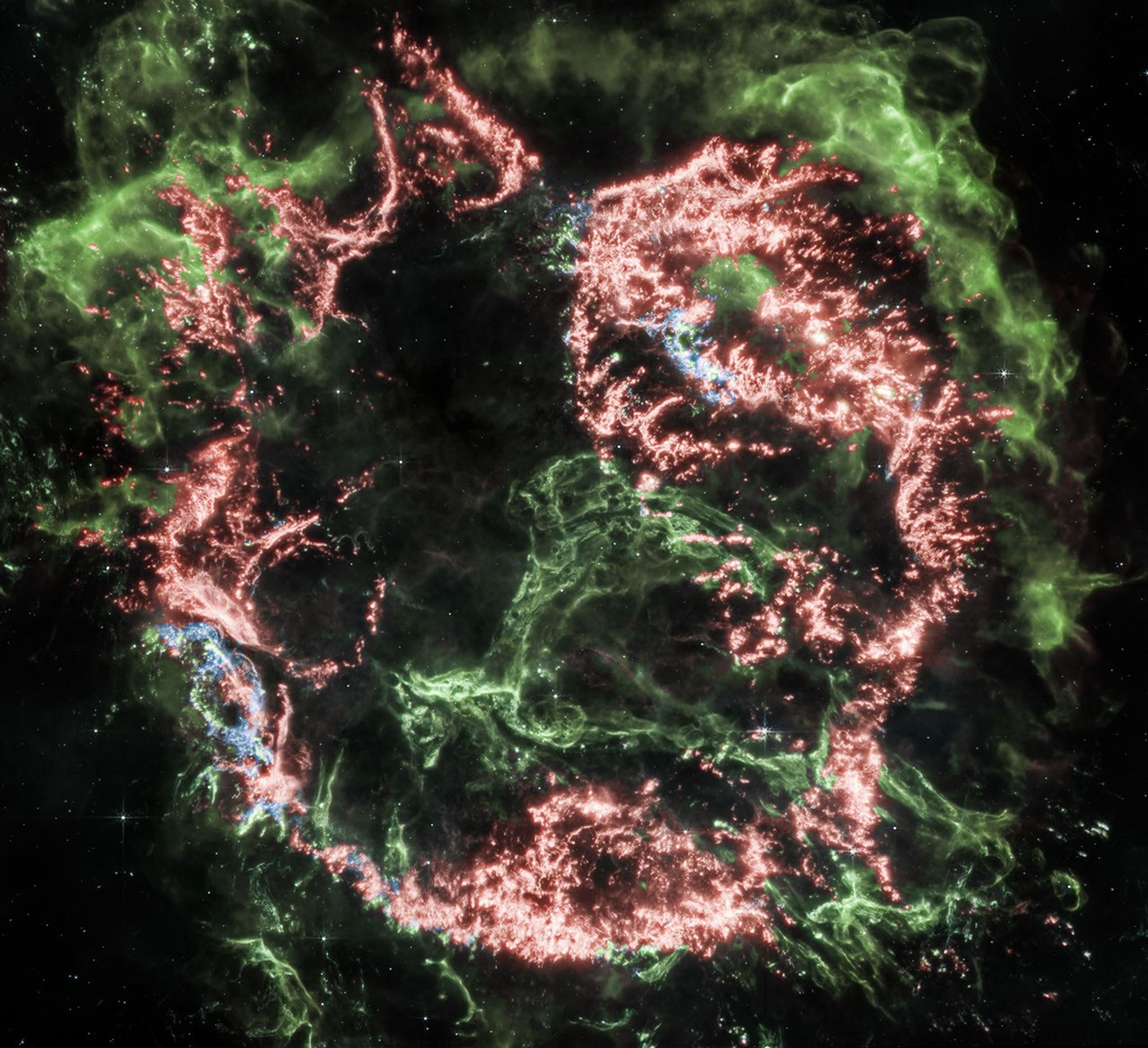
NASA's James Webb Space Telescope has provided new insights into the evolution of stars by studying the supernova remnant Cassiopeia A. The telescope's high-resolution, mid-infrared observation of the remnant has revealed the composition of its dust, which offers clues to the structure of the original star.
The dust is made up of various elements, including silica, carbon, and magnesium silicates, which were formed through the fusion of lighter elements in the star's core. The study of Cassiopeia A's dust has helped astronomers understand the star's evolutionary history, including the process of shell merger, where the layers inside a star mix before the explosion.
This process can cause significant changes to the star's structure and chemical abundances, which are then reflected in the composition of the dust. The researchers used data from NASA's retired Spitzer Space Telescope to identify key regions to observe with Webb, and the telescope's keen eye has provided finer details into the chemistry of the remnant's dust.
The findings, published in The Astrophysical Journal Letters, have shed new light on the life cycle of stars and the formation of new stars and planets. The study has also demonstrated the capabilities of the James Webb Space Telescope in studying the universe in unprecedented detail.
The telescope's observations of Cassiopeia A have painted a vibrant tapestry of the supernova remnant, revealing new details that are helping astronomers chronicle the structure and evolution of the original star.