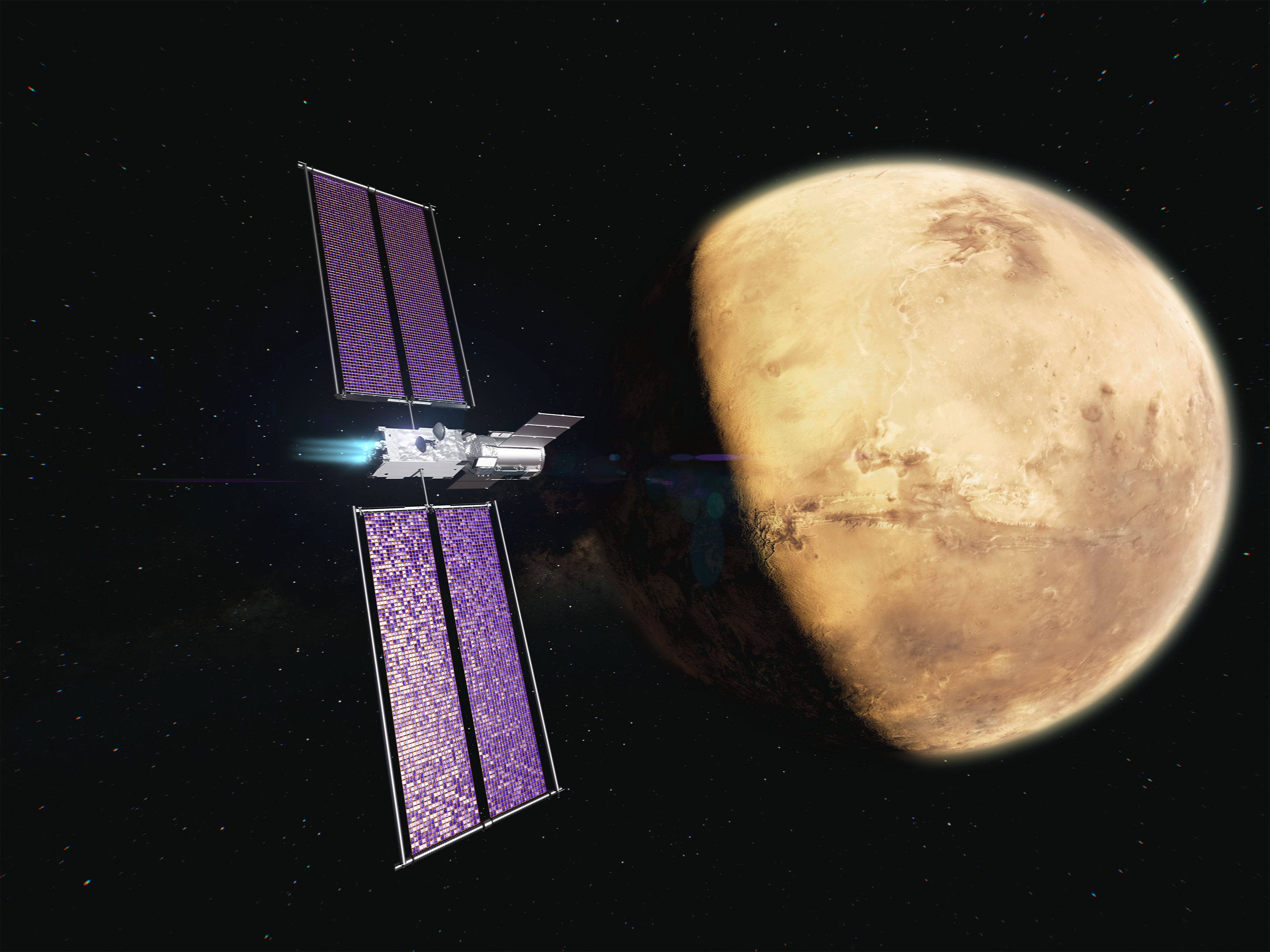
5 min read Preparations for Next Moonwalk Simulations Underway (and Underwater) NASA’s Space Reactor-1 (SR-1) Freedom, the first fission-powered spacecraft to travel beyond Earth orbit, cruises past Mars in this artist’s concept, demonstrating nuclear electric propulsion in deep space.
Credit: NASA/Jonathan North NASA completed a major review for Space Reactor-1 (SR-1) Freedom and locked in key elements of the spacecraft, which is targeted to launch in 2028 and demonstrate nuclear electric propulsion in deep space for the first time.
Experts from across the agency, the U.S. Department of Energy (DOE), and industry met at NASA’s Glenn Research Center in Cleveland for a major SR-1 mission design review in October. Several key decisions were made, propelling the mission from an early concept toward a defined spacecraft design.
“SR-1 marks a pivotal step in how we travel through the solar system,” said Steve Sinacore, SR-1 Freedom program director.
Credit: NASA/Jonathan North NASA completed a major review for Space Reactor-1 (SR-1) Freedom and locked in key elements of the spacecraft, which is targeted to launch in 2028 and demonstrate nuclear electric propulsion in deep space for the first time. Experts from across the agency, the U.S.
Department of Energy (DOE), and industry met at NASA’s Glenn Research Center in Cleveland for a major SR-1 mission design review in October. Several key decisions were made, propelling the mission from an early concept toward a defined spacecraft design. “SR-1 marks a pivotal step in how we travel through the solar system,” said Steve Sinacore, SR-1 Freedom program director.
“This mission will be the first freight run on the railroad of the solar system, and the decisions we’re making now are laying the tracks for every nuclear-powered spacecraft that follows.” Planned for launch in late 2028, SR-1 will use both nuclear and solar power to deliver SkyFall , a capsule carrying three next-generation helicopters, to Mars.
Once deployed, the helicopters will study Martian geology and climate history, explore new terrain, and search for signs of subsurface ice. As NASA prepares for more ambitious exploration missions, future spacecraft and surface operations will require significantly more power than current systems can provide, particularly in environments where sunlight is limited or unavailable.