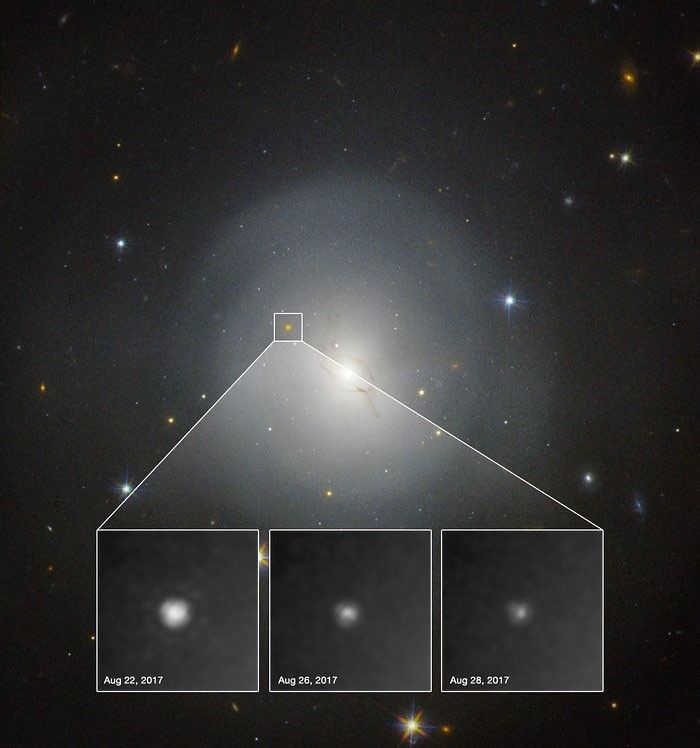
Explore This Section Science Citizen Science Amateur Astronomer? Be a… Overview Resources Opportunities Citizen Science Highlights About Science Activation Neutron stars are the ultra-dense, city-sized leftovers of dead stars. When they collide, they can release a brief flash of light called a kilonova .
These immensely powerful events forge much of the universe’s gold, platinum and other heavy elements. Since a kilonova fades within days, astronomers have to find it fast, and no single observatory can watch the whole sky. But if you have a telescope with a camera, or access to one, you can help find and follow these cosmic fireworks as a part of NASA’s Kilonova Catcher project!
Kilonova Catcher connects amateur astronomers around the world into a rapid-response network. When gravitational wave detectors or space telescopes send out an alert, volunteers point their own telescopes at the sky to help find and track the fading light.
The network also follows up on gamma-ray bursts, the most powerful explosions in the universe, and catches other short-lived cosmic events whenever the opportunity arises. The Kilonova Catcher network has more than 150 registered members on several continents. Volunteers work side by side with professional astronomers and observatories.
They have already contributed to more than 64 official reports shared through NASA’s General Coordinates Network, the system scientists use to share discoveries in real time. Volunteers’ observations have been credited for their contributions by being named authors in peer-reviewed scientific research papers.