For more information, contact Joel W. Sills, Langley Research Center, [email protected] . Download PDF here Chip resistors are widely used in NASA projects, yet cases of alumina substrate cracking during environmental testing are rare. Two instances of thick-film chip resistor cracking were observed during thermal cycling after vibration, with fractures occurring across the short axis due to bending.
Failure analyses ruled out defective lots and fatigue, identifying board flexure, component orientation, excessive solder, and mounting stresses as contributing factors. The bulletin recommends careful component placement, finite element analysis, controlled solder fillet height, thorough inspection, and functional thermal shock testing to mitigate flexure-induced cracking risks in ceramic body components on printed circuit boards.
Background The NESC noted historical lack of reported cases of chip resistors’ alumina substrate cracking during vibration and thermal cycling, although chi
Two instances of thick-film chip resistor cracking were observed during thermal cycling after vibration, with fractures occurring across the short axis due to bending. Failure analyses ruled out defective lots and fatigue, identifying board flexure, component orientation, excessive solder, and mounting stresses as contributing factors.
The bulletin recommends careful component placement, finite element analysis, controlled solder fillet height, thorough inspection, and functional thermal shock testing to mitigate flexure-induced cracking risks in ceramic body components on printed circuit boards.
Background The NESC noted historical lack of reported cases of chip resistors’ alumina substrate cracking during vibration and thermal cycling, although chip resistors are ubiquitous across NASA projects. Two instances of thick film chip resistor body cracking were observed during environmental acceptance testing on printed circuit board assemblies.
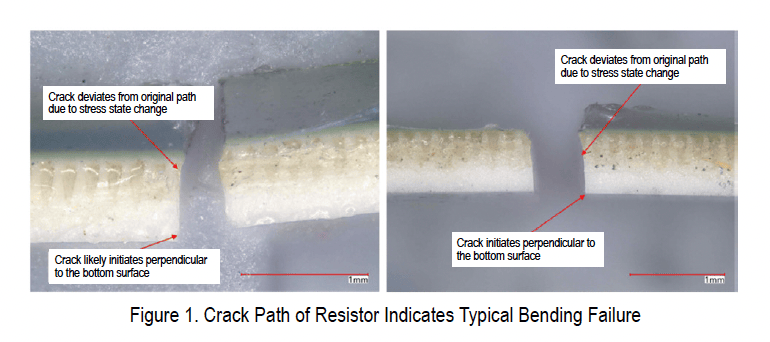
Both failures occurred during thermal cycling after vibration testing, exhibiting intermittent open circuit failures at hot dwell temperatures that recovered at room temperature. Transverse fracture occurred at the mid-span of each resistor, running parallel to the terminations.