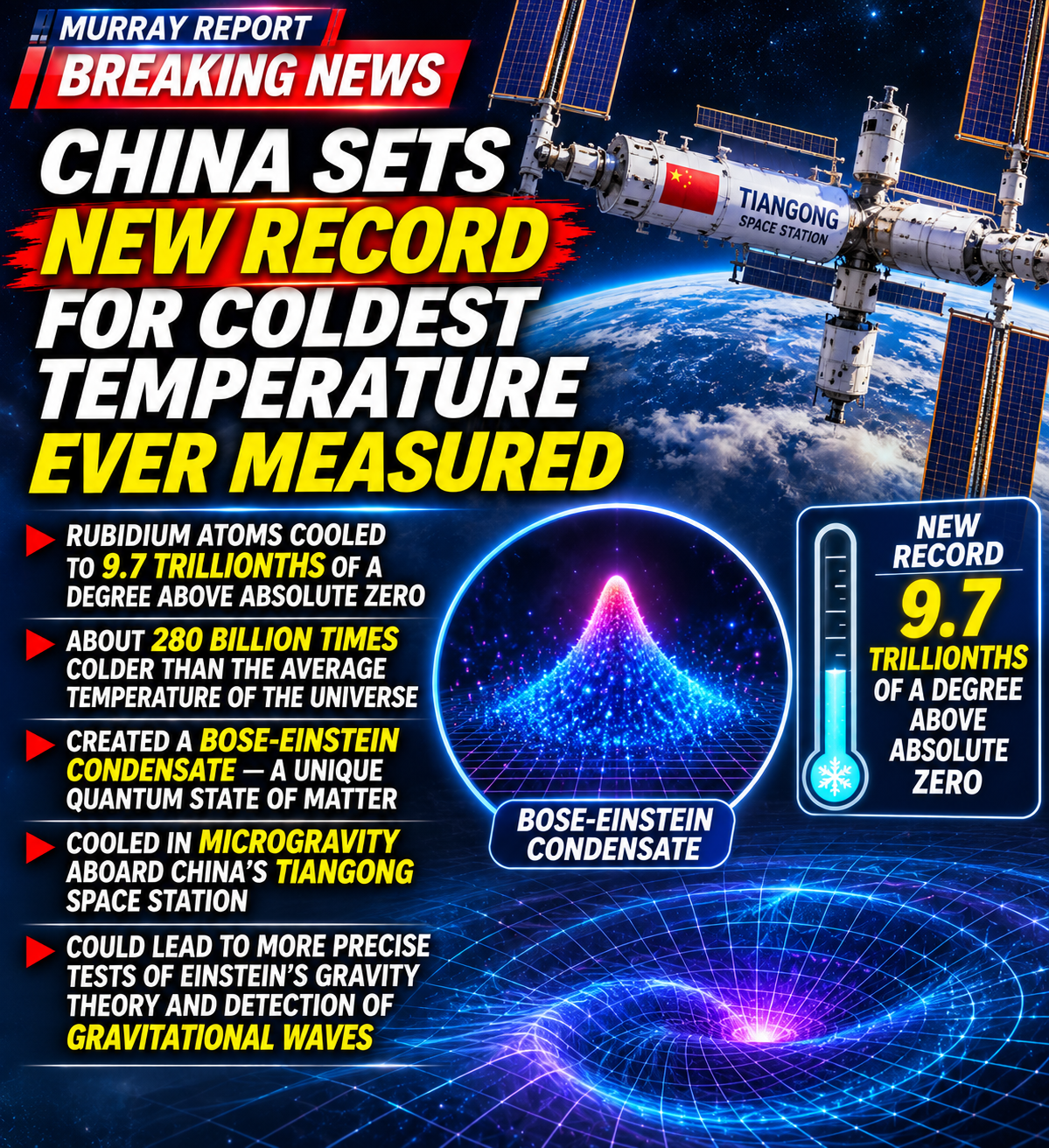
SPACE & SCIENCE: MurrayReport — Scientists conducting experiments aboard China's Tiangong space station have reportedly established a new record for ultracold atomic research, lowering the temperature of a cloud of atoms to an astonishing 9.7 trillionths of a degree above absolute zero.
The achievement represents a significant development in quantum physics, demonstrating how the unique environment of space can help scientists explore matter under conditions that are extremely difficult to reproduce on Earth.
According to the reported findings, researchers cooled approximately 20,000 rubidium atoms to a temperature of 9.7 picokelvin, or 0.0000000000097 kelvin.
That temperature is roughly 280 billion times colder than the average temperature of the universe.
Scientists Create Extraordinary Quantum State in Space
The experiment involved producing a Bose-Einstein condensate, an unusual state of matter that forms when certain atoms are cooled extremely close to absolute zero.
Under these conditions, atoms begin behaving collectively, displaying quantum properties that are normally difficult to observe on a large scale.
Rather than acting as entirely independent particles, the atoms can exhibit wave-like behavior as a coordinated quantum system.
Researchers used Tiangong's microgravity environment to help maintain and study this fragile state of matter.
The absence of strong gravitational effects allowed the atomic cloud to evolve under conditions that would be more challenging to sustain in a conventional terrestrial laboratory.
Laser Cooling Pushes Temperature to New Record
After creating the Bose-Einstein condensate, scientists employed additional laser-based techniques to reduce the atoms' motion and bring their effective temperature even closer to absolute zero.
The reported result surpassed a previous ultracold temperature record of 38 picokelvin established in 2021.
Absolute zero, equivalent to minus 273.15 degrees Celsius or minus 459.67 degrees Fahrenheit, represents the lowest possible temperature on the conventional thermodynamic scale.
Although the scientists came extraordinarily close to this limit, they did not actually reach absolute zero.
The reported achievement concerns the temperature of a specially prepared atomic cloud, rather than the ambient temperature inside the space station.
Microgravity Allows Seven Seconds of Observation
One of the experiment's significant accomplishments involved observing the ultracold cloud expanding freely for seven seconds.
This extended observation period enabled researchers to examine the behavior of atoms under extremely low-temperature conditions.
Space-based experiments offer important advantages because microgravity reduces the rapid downward movement that ordinarily limits how long unsupported atomic clouds can be studied on Earth.
Longer observation times can improve the precision of measurements and provide scientists with additional opportunities to investigate quantum behavior.
Could the Discovery Help Test Einstein's Theory?
The potential applications extend beyond setting a laboratory temperature record.
Ultracold atoms can serve as highly sensitive tools for studying gravitational forces, acceleration, and other physical phenomena.
Researchers hope advances in this field will contribute to more precise instruments capable of testing predictions associated with Albert Einstein's theory of gravity.
Related quantum sensing technologies may also support investigations into gravitational waves and subtle physical effects that are difficult to measure using conventional equipment.
These are potential future applications rather than demonstrated results of the Tiangong experiment.
A New Frontier for Quantum Research
The reported achievement highlights the growing importance of space-based laboratories in experimental physics.
By combining sophisticated laser systems, atomic cooling techniques, and microgravity, researchers can create conditions that reveal aspects of matter rarely accessible in everyday environments.
The Tiangong experiment could contribute to future advances in quantum sensors, precision measurement, and fundamental physics.
As scientists continue exploring temperatures approaching absolute zero, experiments like this may provide new insight into how matter and gravity behave at the smallest measurable scales.
Source: Daily Mail, based on the scientific report supplied.