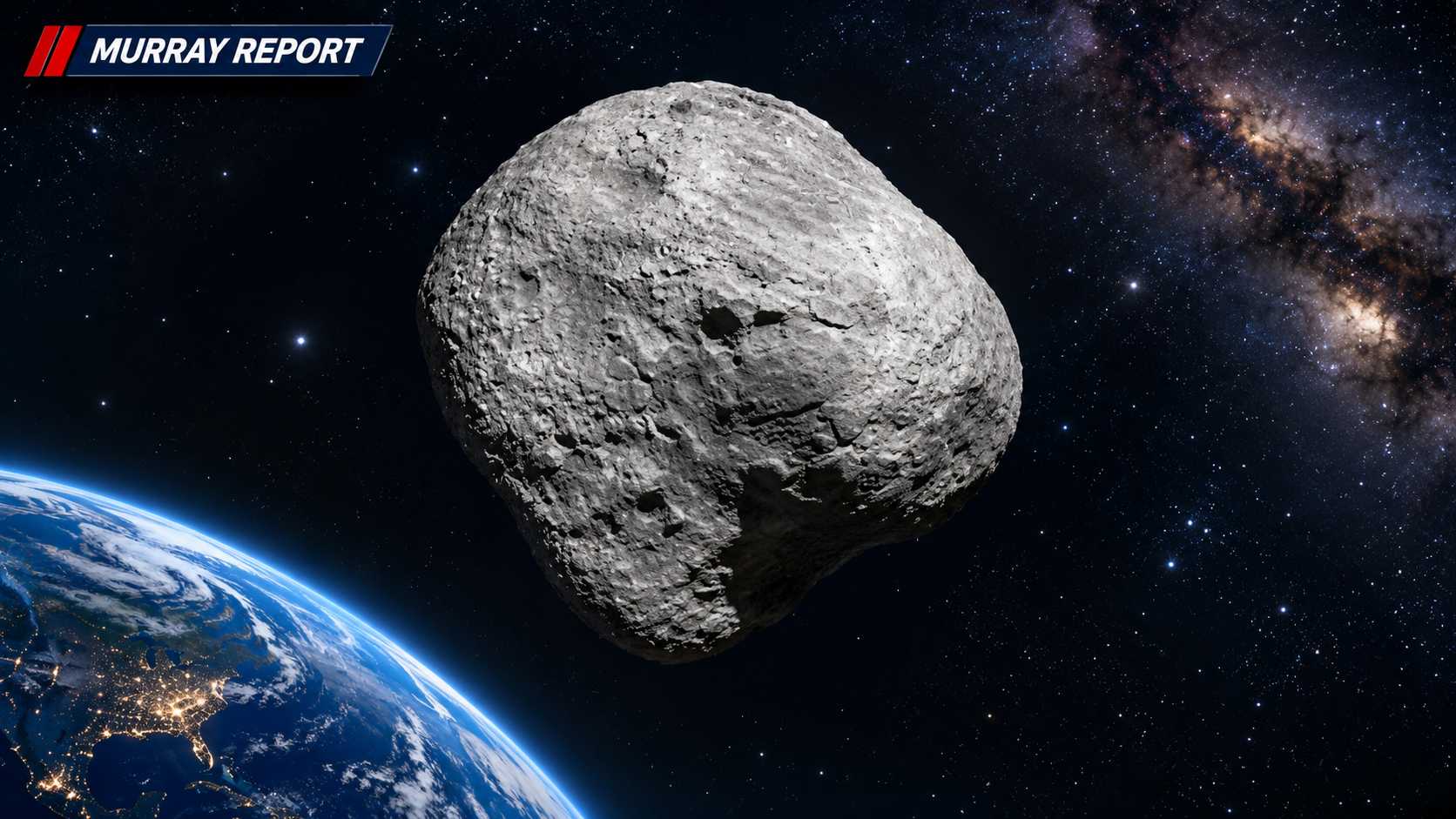
Posted by R MurraySPACE & SCIENCE — November 17, 2026. A small, fast-moving object traveling around the Sun has attracted renewed attention from astronomers after observations revealed that its movement cannot be fully explained by gravity alone.
The object, officially designated 1998 KY26, measures approximately 36 feet across and has become the subject of competing scientific explanations involving asteroids, comets, solar radiation and even a spacecraft that disappeared decades ago.
Although several theories have generated considerable interest, recent research suggests that sunlight itself may explain the object's unusual behavior.
Strange Motion Raises Questions About Its Identity
First discovered in 1998 by University of Arizona astronomer Tom Gehrels, 1998 KY26 was initially classified as an asteroid.
Astronomers later identified subtle deviations in its trajectory that could not be accounted for by gravitational forces alone.
These deviations are extremely small but significant when scientists attempt to calculate the precise movements of objects traveling through the solar system.
Such unexplained acceleration can indicate that additional physical forces are influencing an object's orbit.
The unusual behavior led researchers to question whether 1998 KY26 was an ordinary asteroid or something more complicated.
Could the Object Be a Dark Comet?
One early explanation involved the possibility that 1998 KY26 belonged to a category of objects known as dark comets.
Unlike familiar comets that develop visible tails of gas and dust, dark comets may exhibit comet-like motion without displaying an obvious tail.
The acceleration can potentially result from sublimation, a process in which frozen material changes directly into gas as solar heating increases.
Gas escaping from an object can create a small force that gradually changes its trajectory.
Michigan State University astrophysicist Darryl Seligman was among the researchers who considered this explanation.
However, a newer study published in the scientific journal Icarus challenged the hypothesis.
Researchers estimated the object's average temperature at approximately minus 53 degrees Fahrenheit, which they argued was too warm for the proposed ice-driven explanation under the modeled conditions.
That finding complicated the idea that escaping gases from buried ice were responsible for its acceleration.
Harvard Scientist Suggests Lost Soviet Spacecraft
Another theory came from Harvard astrophysicist Avi Loeb.
Loeb proposed that 1998 KY26 might actually be Phobos 1, a Soviet spacecraft launched toward Mars in 1988.
The uncrewed probe lost contact with Earth approximately two months after launch.
Loeb suggested that the object's unusual motion warranted consideration of whether it could be artificial rather than naturally occurring.
He presented the proposal in a research paper coauthored and posted online earlier in 2026.
However, other scientists have challenged that interpretation.
NASA Administrator Jared Isaacman publicly rejected suggestions that the object was a spacecraft, saying the available evidence supported an asteroid interpretation.
Planetary scientist Bryce Bolin also questioned the spacecraft theory, pointing to measurements indicating that 1998 KY26 has a density consistent with rocky material.
The spacecraft hypothesis remains unsubstantiated.
New Measurements Reveal a Much Smaller Object
A significant development came from research published in 2025 that revised estimates of the object's physical size.
Scientists determined that 1998 KY26 was only about one-third as wide as previously believed.
The revised diameter, approximately 36 feet, changed how researchers evaluated the forces affecting its movement.
Smaller objects can be more strongly influenced by subtle non-gravitational forces than larger bodies.
That discovery provided an important clue and encouraged scientists to reconsider explanations that previously appeared insufficient.
NASA Points to Sunlight as Possible Explanation
A team including NASA Jet Propulsion Laboratory navigation engineer Davide Farnocchia subsequently examined whether solar energy could explain the object's unusual acceleration.
Their research suggested that radiation pressure from sunlight could be an important factor.
Although individual particles of light carry very little momentum, the combined effect of enormous numbers of photons can produce measurable forces on small objects.
Scientists also considered the Yarkovsky effect.
This phenomenon occurs when an object absorbs sunlight and later releases that energy as heat, producing a subtle force that can gradually alter its orbit.
For a relatively small asteroid such as 1998 KY26, these effects can become important when calculating long-term motion.
In a statement released Sunday, NASA identified solar radiation forces as influencing the object's movement.
The findings provide a natural physical explanation for behavior that initially appeared mysterious.
Japan Cancels Planned Spacecraft Encounter
Scientists had anticipated that Japan's Hayabusa2 spacecraft could provide direct observations of 1998 KY26.
The Japanese space agency originally planned for the probe to reach the object in 2031.
Such an encounter could have provided detailed information about its surface, shape, rotation and composition.
However, Japanese authorities announced Monday that the planned visit had been canceled because of engine problems.
The spacecraft will instead target another asteroid, 2015 BM510, with an anticipated encounter in 2028 or 2029.
The cancellation means scientists will not receive the close-range observations of 1998 KY26 that had been expected from the original mission plan.
Is the Object a Threat to Earth?
Despite the attention surrounding its unusual movement, researchers have not identified 1998 KY26 as an imminent danger to Earth.
Scientists monitor near-Earth objects to evaluate their orbital paths and determine whether they could pose future collision risks.
Seligman expressed confidence in the work of planetary defense organizations, including NASA's Planetary Defense Coordination Office.
The available report does not identify a predicted collision with Earth.
Mystery Highlights the Complexity of Our Solar System
The debate surrounding 1998 KY26 illustrates how even relatively small objects can challenge astronomers' understanding of orbital dynamics.
Early suggestions involving cometary activity and artificial spacecraft origins generated considerable discussion.
However, new measurements and research into solar radiation provide a scientific explanation that does not require extraordinary assumptions.
Questions about the object's detailed physical properties remain, especially following the cancellation of the planned Hayabusa2 encounter.
For now, 1998 KY26 remains an example of how improved observations and precise measurements can transform scientists' understanding of seemingly unexplained behavior in space.
Murray Report will continue covering developments involving 1998 KY26, near-Earth objects and scientific investigations into unusual activity throughout the solar system.
Source: The New York Times, based on the supplied article, citing research in Icarus, Nature Communications and The Astrophysical Journal Letters.
Murray Report | Space, Astronomy & Scientific Discoveries