Major Technology Failures Raise Alarms Over America's Digital Infrastructure
Posted by: MurrayReport
A series of major technology outages across the United States has sparked growing concerns about the vulnerability of America's critical digital infrastructure, with a prominent cybersecurity expert warning that artificial intelligence could accelerate a potentially devastating wave of cyber threats.
The disruptions affected major corporations, commercial aviation, banking systems and national security communications, raising questions about the resilience of increasingly interconnected technology networks.
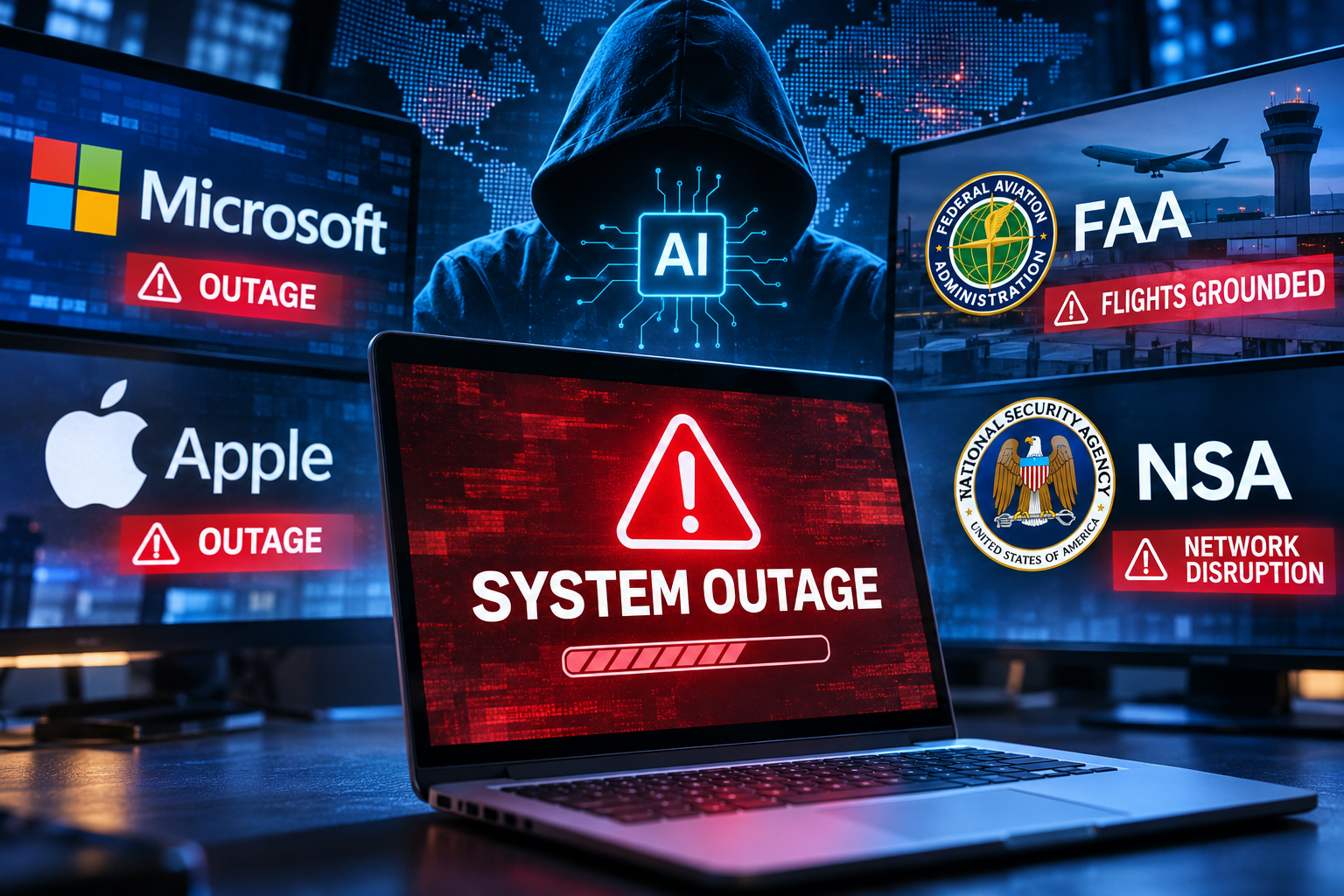
Microsoft, Apple, the Federal Aviation Administration (FAA) and the National Security Agency (NSA) were among the organizations experiencing significant technical problems during the same week.
Although federal officials insist there is no evidence of coordinated cyberattacks, cybersecurity experts warn that the rapid expansion of artificial intelligence could make future disruptions more frequent and potentially more dangerous.
Cybersecurity Expert Warns of an Approaching 'Vulncalypse'
Cybersecurity expert Nicole Perlroth raised concerns about the growing risks associated with AI-powered cyber capabilities, describing a potential future crisis as an "everything everywhere all at once" scenario.
Perlroth used the terms "vulnageddon" and "vulncalypse" to characterize the possibility of widespread exploitation of vulnerabilities across critical technological systems.
According to Perlroth, artificial intelligence is dramatically increasing the speed at which malicious actors can discover and exploit software weaknesses.
She claimed that high-severity and critical vulnerabilities had tripled during the first 10 months of 2026 compared with the same period in 2025.
The concern is that AI could allow cybercriminals and foreign adversaries to identify security flaws faster than software developers and cybersecurity teams can repair them.
Such capabilities could potentially threaten financial institutions, transportation networks, government communications and other essential services.
Nationwide Outages Disrupt Flights, Banking and Communications
The warnings followed several major technology failures that disrupted operations across the country.
Microsoft experienced a widespread outage affecting email communications and business operations.
The following day, the FAA ordered a nationwide ground stop that lasted approximately four and a half hours, disrupting thousands of flights.
The incident was described as the longest nationwide aviation shutdown since the September 11, 2001, terrorist attacks.
Banking services subsequently experienced software-related problems, while United Airlines reported technical difficulties that delayed approximately 150 flights.
Apple also acknowledged an outage affecting services including iCloud and Apple Pay.
The company attributed its problems to an internal software update and stated that the disruption was not caused by a cyberattack.
Meanwhile, the NSA confirmed that technical problems had affected its internal communications infrastructure.
An agency spokesperson said the disruption resulted from scheduled routine maintenance and emphasized that mission-critical national security capabilities remained operational.
Secretary of State Marco Rubio Denies Evidence of Coordinated Cyberattacks
Secretary of State Marco Rubio moved to reassure Americans that the series of outages did not appear to be connected.
Speaking during a press conference in Manila, Rubio said federal officials had found no evidence suggesting that cybercriminals, hostile foreign governments or other malicious actors were responsible.
Rubio acknowledged that the frequency of the disruptions was unsettling but maintained that the incidents appeared to have separate causes.
He also explained that technology companies regularly identify vulnerabilities and deploy software updates to address security concerns.
Those updates can sometimes produce unexpected technical problems, temporarily interrupting services.
When questioned about whether artificial intelligence could have contributed to the outages, Rubio declined to speculate.
President Trump Downplays Concerns Over Technology Failures
President Donald Trump also dismissed suggestions that the outages indicated an immediate national cybersecurity crisis.
Speaking to reporters in Manila during meetings involving the Association of Southeast Asian Nations, Trump suggested that occasional technical problems are inevitable within large and complex systems.
"It's like when you're big and powerful, and you have all the money. Things like that happen. It's fine," Trump said.
The president's comments came as the repeated disruptions raised broader questions about whether government agencies and private technology companies have reduced technical staffing too aggressively while increasing their dependence on automated systems.
However, the available information does not establish that staffing reductions contributed to the outages.
Could Artificial Intelligence Trigger a Larger Cybersecurity Crisis?
The incidents have renewed concerns about the growing dependence of American infrastructure on sophisticated software systems and artificial intelligence.
While AI offers major advantages for businesses and government agencies, cybersecurity researchers warn that the same technology can potentially strengthen the capabilities of cybercriminals.
Advanced AI systems can assist with identifying coding vulnerabilities, analyzing networks and automating technically complex processes.
In the wrong hands, those capabilities could make cyberattacks faster, more sophisticated and more difficult to defend against.
Experts are particularly concerned about attacks targeting systems that support essential services, including financial transactions, aviation operations, emergency communications and national security.
However, there is currently no established evidence that the recent Microsoft, Apple, FAA and NSA disruptions were part of a coordinated attack or resulted from malicious AI activity.
Growing Dependence on Technology Raises National Security Questions
The frequency of the recent outages highlights a fundamental challenge facing both the federal government and private industry: maintaining reliable digital infrastructure as technology becomes increasingly complex.
Even routine software updates can produce significant disruptions when interconnected systems support millions of customers and essential operations.
The potential consequences become considerably more serious when failures affect air transportation, financial institutions or sensitive government communications.
For cybersecurity specialists, the central question is whether existing safeguards can keep pace with advances in artificial intelligence and the accelerating discovery of software vulnerabilities.
Although federal officials continue to downplay the possibility of a coordinated cyberattack, the recent disruptions have demonstrated how quickly technical failures can affect major sectors of the American economy.
As artificial intelligence becomes increasingly integrated into critical infrastructure, the warnings of a potential "vulncalypse" underscore a growing concern: whether America's digital defenses are prepared for the next generation of technological threats.
SEO Keywords: Major tech outages 2026, Microsoft outage, Apple outage, FAA ground stop, NSA communications outage, AI cybersecurity threats, vulncalypse, Nicole Perlroth, Trump tech outages, Marco Rubio cybersecurity, critical infrastructure security.
Source Attribution: Reuters / NDTV