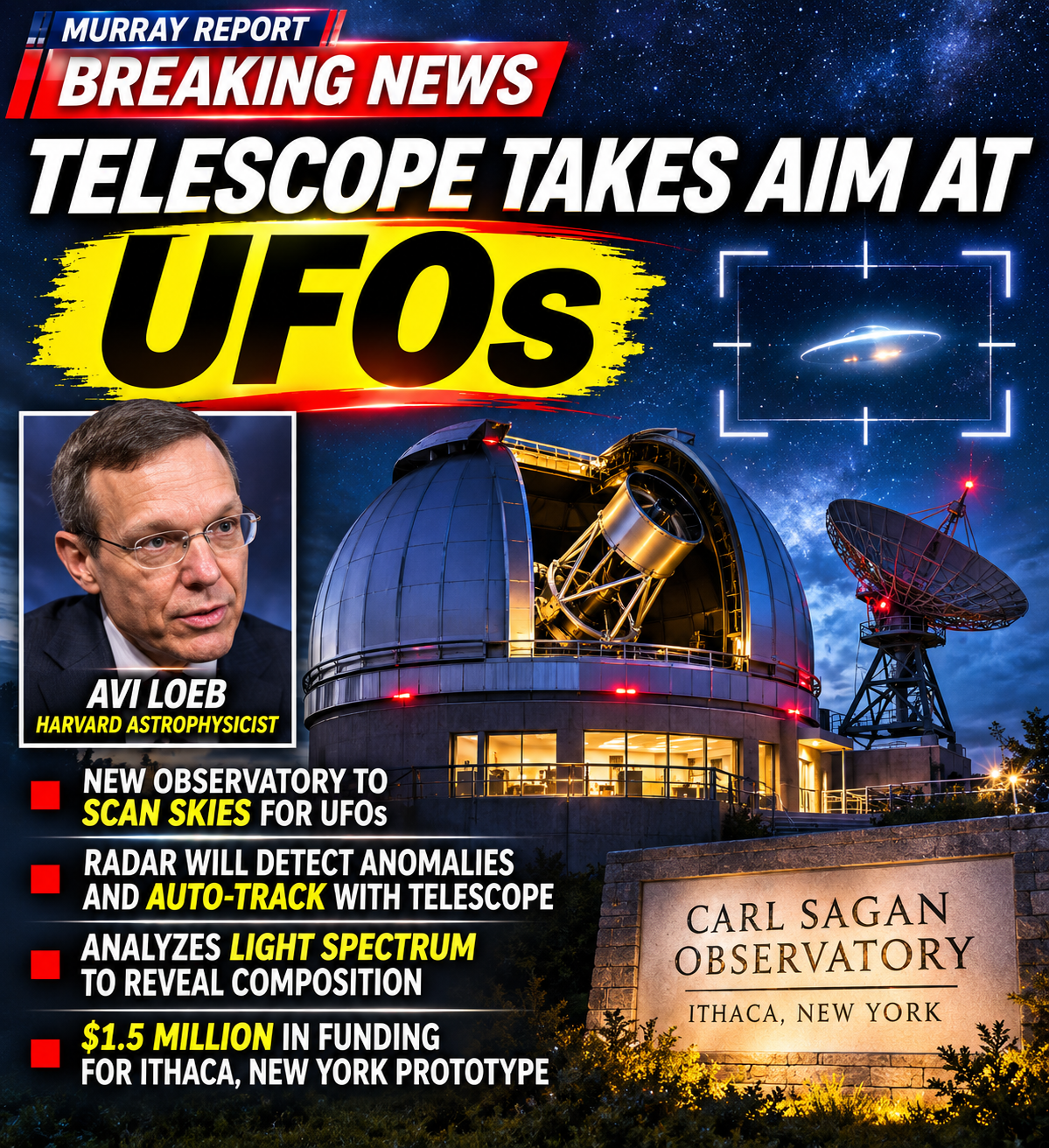
MurrayRpoert: SCIENCE & SPACE — Harvard astrophysicist Avi Loeb is proposing a new method of investigating unidentified flying objects, one that could replace speculation and eyewitness testimony with direct scientific measurements.
The initiative would combine radar surveillance, automated telescope tracking, advanced photography, and light-spectrum analysis to investigate unidentified aerial phenomena, commonly known as UAPs or UFOs.
Rather than relying exclusively on government disclosures or eyewitness reports, Loeb wants researchers to collect independent evidence using instruments specifically designed to detect and examine unusual objects in Earth's atmosphere.
Radar System Would Automatically Target Unidentified Objects
During a recent interview with NewsNation, Loeb described plans for an observatory equipped with radar technology capable of continuously monitoring the sky.
When the system detects an unusual object or movement pattern, its technology would automatically direct a powerful telescope toward the target.
The telescope would then attempt to capture detailed images while collecting additional information about the object's physical characteristics.
One important part of the proposed system involves spectroscopy, a scientific technique that examines light to help identify the materials or physical conditions associated with an observed object.
Combining these measurements could give researchers a more complete understanding of unexplained aerial sightings than ordinary photographs or witness descriptions alone.
$1.5 Million Project Targets New York Observatory
According to the report, the project has received approximately $1.5 million in funding.
A prototype installation is planned for an observatory in Ithaca, New York, at a property formerly associated with astronomer Carl Sagan.
The proposed location would provide a site for testing the automated detection system and determining how effectively its instruments can identify and track unusual aerial activity.
Loeb has also discussed the initiative at the Pentagon, reflecting his interest in applying scientific research methods to a subject that has attracted attention from government agencies and the public.
Could Advanced Technology Finally Explain UFO Sightings?
A major objective of the project is to distinguish ordinary objects from genuinely unexplained phenomena.
Aircraft, drones, balloons, atmospheric effects, and military technology can produce observations that are initially difficult to identify.
By gathering detailed imaging, radar measurements, and spectral information, researchers hope to narrow the possible explanations for unusual sightings.
The system could also provide a way to examine observations that do not immediately fit established categories.
However, an unidentified object is not necessarily evidence of extraterrestrial technology. Determining what an object represents requires reliable measurements and careful analysis.
Loeb Calls for Scientific Evidence Rather Than Speculation
Loeb's approach emphasizes the importance of investigating unusual observations without automatically dismissing them or assuming they originate beyond Earth.
His proposal aims to shift the discussion away from competing claims and toward independently collected data that scientists can examine.
The larger scientific challenge is obtaining sufficient information about unusual objects to determine their identity, composition, movement, and possible origin.
If successfully developed, the automated observatory could provide researchers with a new tool for investigating aerial mysteries using established scientific methods.
A New Era of UFO Research?
The proposed radar-guided telescope system represents an attempt to make UFO investigations more systematic and evidence-driven.
Although the project has not established the existence of extraterrestrial spacecraft or other extraordinary technology, its planned instruments could improve the quality of information available to researchers.
For Loeb, the central question is not whether the public should believe every unusual sighting, but whether modern science can develop the tools necessary to investigate those sightings objectively.
The planned prototype could help determine whether automated observations offer a practical path toward answering longstanding questions about unidentified objects in the sky.
Murray Report will continue following developments in the project and the scientific investigation of unidentified aerial phenomena.
Source: Coast to Coast AM / NewsNation interview with Avi Loeb.