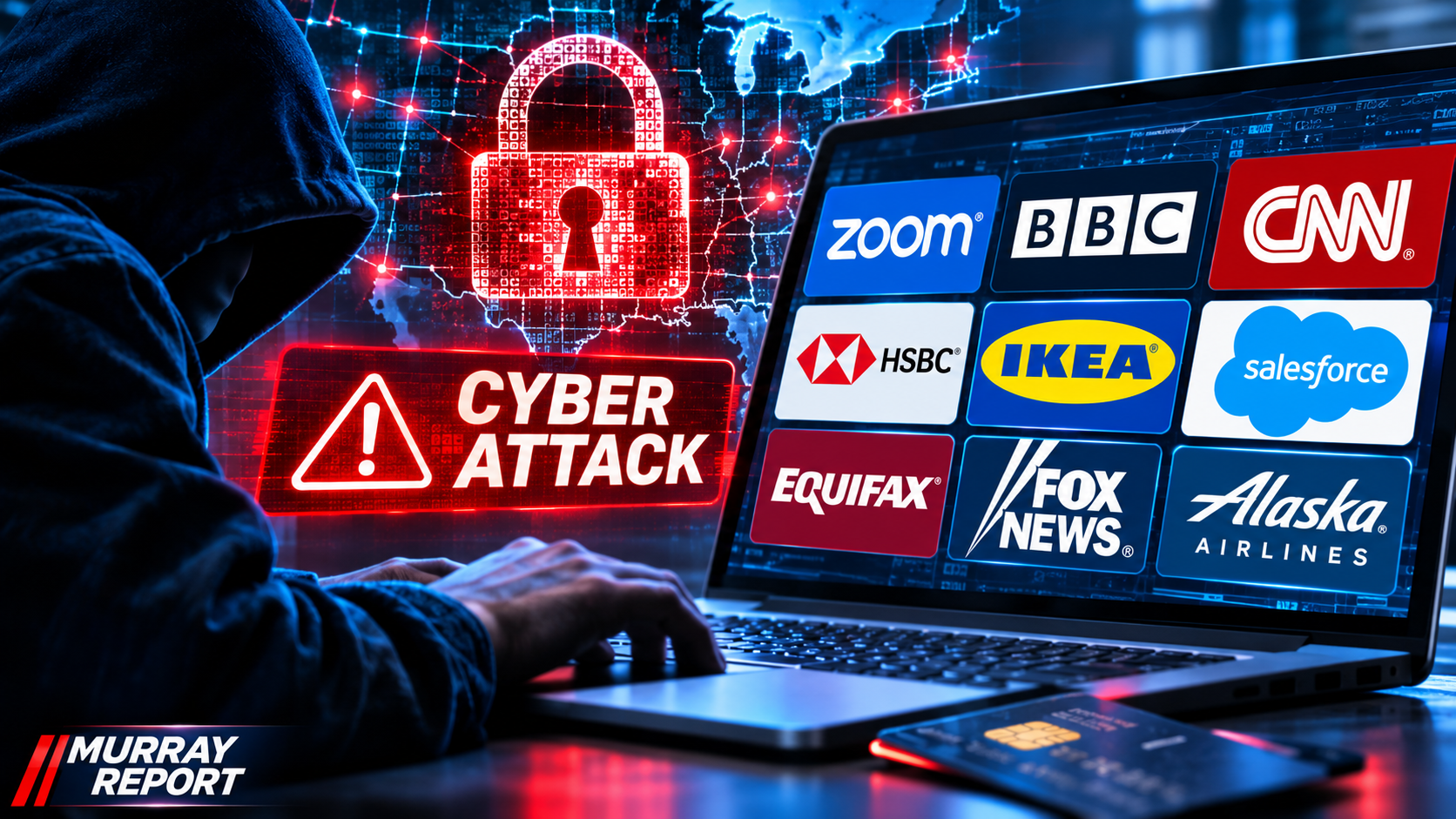
MurrayReport: CYBERSECURITY NEWS — November 17, 2026. A widespread cyberattack involving software used by some of the world's largest organizations has raised serious security concerns after researchers discovered malicious code embedded in website services associated with 178 organizations.
The incident potentially exposed visitors to attempts to steal credit card information, manipulate cryptocurrency transactions and exploit vulnerabilities in certain Apple devices.
Among the organizations identified in the investigation were JPMorgan competitors HSBC and Equifax, technology companies Zoom and Salesforce, major news organizations CNN and the BBC, and international retailer IKEA.
Cybersecurity researchers at Report URI discovered the suspicious activity on Monday, November 16, identifying 188 affected website scripts across the 178 organizations.
The incident did not necessarily involve direct breaches of each company's internal computer systems. Instead, attackers targeted software supplied by a third-party technology provider used across numerous websites.
Hackers Exploit Software Used by Major Websites
The attack centered on Optimizely, a digital technology company that provides tools businesses use to test website layouts, features and online experiences.
Rather than attempting to infiltrate each organization individually, the attackers compromised software distributed through the service.
That created an opportunity for malicious JavaScript to reach visitors browsing websites that depended on the affected technology.
This type of incident is commonly associated with a third-party software supply-chain compromise, in which a weakness at one technology provider creates security risks for numerous customers.
The danger is that visitors may encounter malicious code while using websites they would ordinarily consider trustworthy.
Malicious Code Designed to Steal Financial Information
According to the researchers, the injected software contained multiple capabilities targeting sensitive information and financial transactions.
One technique involved interfering with cryptocurrency payments by substituting an attacker-controlled wallet address for the address a user intended to copy.
If a victim failed to notice the substitution before completing a transfer, the cryptocurrency could be sent to the wrong recipient.
Other portions of the malicious code were designed to target payment card information, collect browser data and capture screenshots.
Researchers also identified code intended to exploit certain vulnerabilities affecting older versions of Apple's iOS and iPadOS operating systems.
However, the discovery of these capabilities does not establish that every attack method succeeded or that every visitor to an affected website had information stolen.
Researchers Identify Cryptocurrency Payments Linked to Attack
The investigation identified approximately $7,040 in cryptocurrency payments associated with wallets linked to the attack on November 16.
That amount represents transactions traced by researchers, not a confirmed total of stolen funds.
The full financial impact remains undetermined.
Investigators have also not established how many individuals may have exposed personal information, submitted compromised payment details or experienced unauthorized access to their devices.
Additional analysis would be necessary to determine the full scope of the incident.
Optimizely Says Security Problem Has Been Fixed
Optimizely acknowledged the security issue and reported Tuesday that it had removed the malicious code and addressed the underlying problem.
The company's response was intended to prevent the compromised scripts from continuing to expose visitors through the affected service.
However, remediation does not automatically establish whether information was accessed or collected during the period when malicious code was active.
Organizations using the service may need to review their own security records to evaluate potential exposure.
Major Banks, News Organizations and Technology Companies Identified
The investigation identified websites associated with prominent financial institutions, major technology providers, news publishers, retailers, airlines and other businesses.
Financial organizations included several regional HSBC services, Equifax properties and other banking-related platforms.
Technology-related services included Zoom, Salesforce, GitLab and additional enterprise software companies.
News and media properties associated with CNN, BBC, Fox News and NPR were also identified.
Retail and consumer brands included IKEA, Mattel, American Eagle and several international Levi's websites.
The presence of an organization on the affected list does not mean its entire corporate network was compromised. The reported exposure relates to affected website scripts and services.
What Visitors Should Do After the Cyberattack
People who used websites identified in the investigation on November 16 should review any sensitive activity they performed during that period.
Users who entered payment card information should monitor their accounts for transactions they do not recognize.
Anyone who transferred cryptocurrency should verify the destination wallet address and confirm that the payment reached its intended recipient.
Apple device users should install available operating system security updates, particularly when running older software.
Customers should also pay attention to unexpected account login alerts or unauthorized changes to their online accounts.
Those who discover suspicious financial transactions should contact their bank or payment provider promptly.
Simply visiting an affected website does not, by itself, prove that an individual's information was stolen.
Why a Single Software Provider Can Affect Hundreds of Websites
The incident demonstrates a major challenge in modern internet security.
Large organizations increasingly rely on specialized third-party software for advertising, analytics, website testing, customer interactions and other online functions.
These integrations can improve website capabilities, but they also create additional dependencies.
When a shared technology provider is compromised, malicious code can potentially reach many organizations without attackers separately breaking into each one.
Security specialists therefore emphasize the importance of monitoring external scripts, restricting unnecessary software permissions and maintaining rapid procedures for disabling compromised services.
Full List of Organizations and Websites Identified
The investigation identified the following organizations and website properties across multiple industries. Some entries represent individual regional websites, subsidiary services or grouped brands rather than separate parent companies.
Banking and Finance
Paychex; HSBC US; Equifax; SmartAsset; HSBC Hong Kong; ABN AMRO; TaxAct; HSBC Mexico; HSBC Singapore; NetCredit; Associated Bank; S-Pankki; Equifax Canada; Equifax UK; The Work Number; Funding Circle; HSBC Australia; CashNetUSA; OnDeck; ICS Cards; HSBC UAE; HSBC Malaysia; Rest Super; HSBC Taiwan; HSBC Vietnam; HSBC Egypt; HSBC Philippines; SmartAdvisor Match; Compare Club; ABN AMRO Lease; Energy Scout; Hang Seng Investment.
Technology and Software
Zoom; Bitly; Salesforce; GitLab; Optimizely; Mixpanel; Typeform; InMotion Hosting; Wasabi; Perforce/Zend/Puppet; Tableau; Hootsuite; Smartsheet; MuleSoft; Thales/Imperva; Tricentis; Web Hosting Hub; QR Code Generator; ServiceChannel; Brandfolder; Intelex; Enverus; Accruent.
Retail and Fashion
IKEA; ASOS; Mattel; American Eagle; Scheels; Ariat; American Girl; StackSocial; Crocs India; Levi's Japan; Todd Snyder; Levi's Indonesia; Just Russel; Loloi Rugs; Levi's Australia; Levi's Malaysia; Levi's Philippines; Levi's Singapore; Levi's Korea; Levi's New Zealand.
Streaming and Entertainment
Peacock; D&D Beyond; Wizards of the Coast; NOW TV; Zattoo; Crave; Starz; SkyShowtime; Bravo; SeaWorld; WOW (Sky Deutschland); NOW Italia.
News and Media
CNN; BBC; Fox News; NPR; CTV News; Fox Sports; BNN Bloomberg/CP24; TSN; Top Gear; BBC Earth.
Airlines and Travel
Alaska Airlines/Hawaiian Airlines; Transavia; Air France-KLM; KLM Netherlands; Trafalgar; Contiki; Insight Vacations; The Travel Corporation; Costsaver.
Healthcare and Pharmaceuticals
Invisalign; Takeda; Covetrus; iTero; Covetrus Pharmacy; myCovetrus; RaySafe; Takeda Oncology.
Industrial and Manufacturing
Fluke; eMaint; Fluke Networks; Vaillant Germany; Fluke Process Instruments; Fluke Biomedical; Landauer; Vaillant Spain.
Telecommunications
Virgin Media; Virgin Media O2; Vodafone Australia; O2; TPG Telecom; Mint Mobile; TalkTalk.
Cryptocurrency and Trading
Ledger; IG; OANDA/Coinpass; Interactive Investor; TMS Brokers; Betashares.
Insurance
Asurion/uBreakiFix; Mutual of Omaha; Admiral; Securian Financial; eRenterPlan; AKA.
Property and Real Estate
Buildium (managebuilding.com); Loft Living apartments; Buildium; HireAHelper; Flytte.no and sister comparison sites; MovingPlace.
Food and Hospitality
Restaurant ordering sites (order.online); Heineken; Home Chef; Starbucks Canada; Cinnabon.
Home and Smart Home
Resideo; Honeywell Home; myQ; Chamberlain; First Alert.
Nonprofit and Civic Organizations
Change.org; ASPCA; UNICEF USA; DonorsChoose.
Gambling
Betsson; PokerStars; Tombola; Betfred.
Professional Services
Freshfields; CohnReznick; Baringa; Cro Metrics.
Logistics and Shipping
ShipStation/ShipEngine; Stamps.com; ShipEngine.
Automotive
Lucid Motors; O'Brien Glass; Chevrolet dealer network, including Bill Rapp.
Education
Walden University; Perlego; Chamberlain University.
This directory reproduces the affected names and properties reported in the supplied investigation. Overlapping brands and grouped services mean individual entries should not be interpreted as separate confirmed corporate breaches.
Investigation Continues Despite Security Fix
Although Optimizely says it has removed the malicious code, the ultimate impact on website visitors remains uncertain.
The incident underscores how a vulnerability involving one widely used digital service can create potential exposure across industries and international borders.
The central unanswered questions involve whether sensitive customer information was successfully obtained, how many people encountered the malicious software and whether additional affected websites will be identified.
Murray Report will continue following developments involving the Optimizely security incident, affected organizations and potential financial exposure.
Source: Newsweek, citing cybersecurity researchers at Report URI and statements from Optimizely.
Murray Report | Cybersecurity & Technology News