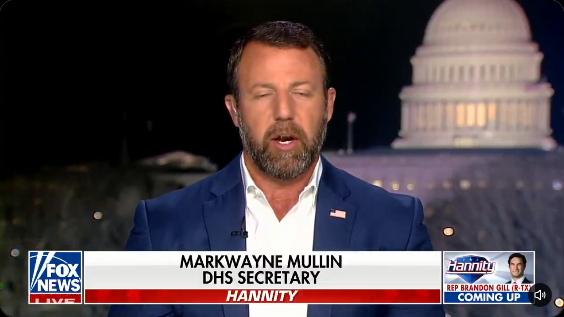
MurrayReport: WASHINGTON — November 16, 2026. Homeland Security Secretary Markwayne Mullin has raised the possibility that rapidly advancing artificial intelligence technology could be contributing to a recent series of major computer system disruptions affecting essential services across the United States.
His comments come after reported outages involving Microsoft 365, Workday, the Federal Aviation Administration, and several major financial institutions over a five-day period.
Mullin said a technology industry expert privately offered an explanation suggesting that modern AI systems may be operating faster than the computer networks and software infrastructure they interact with can reliably handle.
However, the secretary emphasized that authorities have not established a connection between the incidents and that he has seen no evidence indicating a coordinated cyberattack.
DHS Secretary Says AI Could Be Overwhelming Older Computer Systems
According to Mullin, an unnamed technology specialist suggested that artificial intelligence software capable of automatically writing and modifying computer code might create unexpected problems inside existing technology systems.
The expert reportedly explained that when automated programs make changes to one part of a complex system, those modifications can produce unintended consequences elsewhere.
Mullin compared the situation to renovating a house.
Changing one component of a building can affect other areas, creating additional work and complications.
A similar process, the expert suggested, could occur when AI-driven software modifies computer systems that were not originally engineered to accommodate rapid automated changes.
Such interactions could potentially create cascading errors, excessive processing demands, or instability.
This remains a proposed explanation rather than a verified cause of the recent outages.
Unnamed Technology Expert Offered the Theory
Mullin said the individual who discussed the possible AI connection requested anonymity.
The secretary specifically clarified that the person was not Elon Musk.
The expert's identity, technical evidence, and the specific software systems underlying the theory were not disclosed in the information provided.
The reported conversation therefore raises questions about the possible effects of automated software changes but does not establish that artificial intelligence caused any of the disruptions.
Four Major Technology Disruptions Reported in Five Days
The comments followed a series of technology failures affecting different industries.
On November 12, Microsoft 365 reportedly experienced a significant service interruption affecting users of the company's cloud-based productivity services.
The following day, November 13, problems were reported involving Workday, a widely used enterprise management platform.
That same day, the FAA ordered a rare nationwide ground stop after serious instability developed within its air traffic control telecommunications network.
The aviation disruption prevented flight departures for several hours and contributed to extensive delays and cancellations across the country.
On November 16, JPMorgan Chase and customers conducting transactions involving other financial institutions reported banking and payment processing problems.
The initial account also mentioned Bank of America and Wells Fargo in connection with the latest banking complaints.
However, reports of difficulties involving transactions between banks should not automatically be interpreted as evidence that each bank's internal systems experienced a separate outage.
FAA Shutdown Raises Questions About Aging Infrastructure
One of the most significant disruptions involved the FAA's nationwide aviation communications system.
Earlier reports identified excessive network traffic associated with telecommunications equipment installed during modernization work as a central focus of the investigation.
Federal officials examined routers connected to facilities in Arkansas and Texas after abnormal network activity affected numerous air traffic control centers.
The technical investigation into that incident is distinct from the broader suggestion that artificial intelligence may have played a role in recent outages.
No evidence included in Mullin's remarks demonstrates that AI software caused the FAA's router problem.
Mullin Says No Evidence of Coordinated Cyberattacks
Despite the unusual concentration of technology disruptions, Mullin sought to reassure the public about national security and the financial system.
He stated that the homeland remained secure and that Americans' banking system was secure.
The secretary also said investigators were not seeing indications of cyberattacks or evidence that the outages were connected.
That distinction is important because technical failures can occur for many reasons, including configuration mistakes, hardware problems, software defects, maintenance errors, and unexpected network activity.
A series of outages happening close together does not necessarily establish a common cause.
Could AI Create Problems for Critical Infrastructure?
The theory described by Mullin highlights a broader technical concern about increasingly automated software environments.
Artificial intelligence tools can assist developers and system administrators by generating code, identifying problems, and recommending changes.
Some AI-enabled systems can also perform automated operations when specifically configured and authorized to do so.
However, improperly tested software changes—whether created by humans or AI—can introduce defects or cause unexpected interactions with other components.
Older systems may be particularly sensitive to rapid changes when their architecture, testing procedures, or operational safeguards are inadequate.
The possibility of such problems does not mean that AI software independently controls every computer system or that it has been established as the cause of the reported incidents.
Federal Officials Continue Examining the Disruptions
Mullin's comments have introduced a new theory into discussions surrounding the recent failures of critical American technology systems.
Nevertheless, the information provided does not include forensic findings, engineering reports, or other technical evidence linking artificial intelligence to the individual outages.
Determining whether AI contributed to any particular incident would require examining the affected software, configuration changes, network logs, and operational procedures.
For now, the most significant confirmed point in Mullin's reported remarks is that authorities have not identified evidence of coordinated malicious activity connecting the disruptions.
The developments also underscore the importance of reliable infrastructure, controlled software updates, and thorough testing as organizations adopt increasingly powerful automation technologies.
Murray Report will continue following developments surrounding the technology outages, DHS statements, and investigations into potential infrastructure vulnerabilities.
Source: Statements attributed to DHS Secretary Markwayne Mullin and the outage chronology supplied in the original report.
Murray Report | Technology, Cybersecurity & National Security
Editorial note: The potential AI connection is an attributed theory, not an established investigative finding.