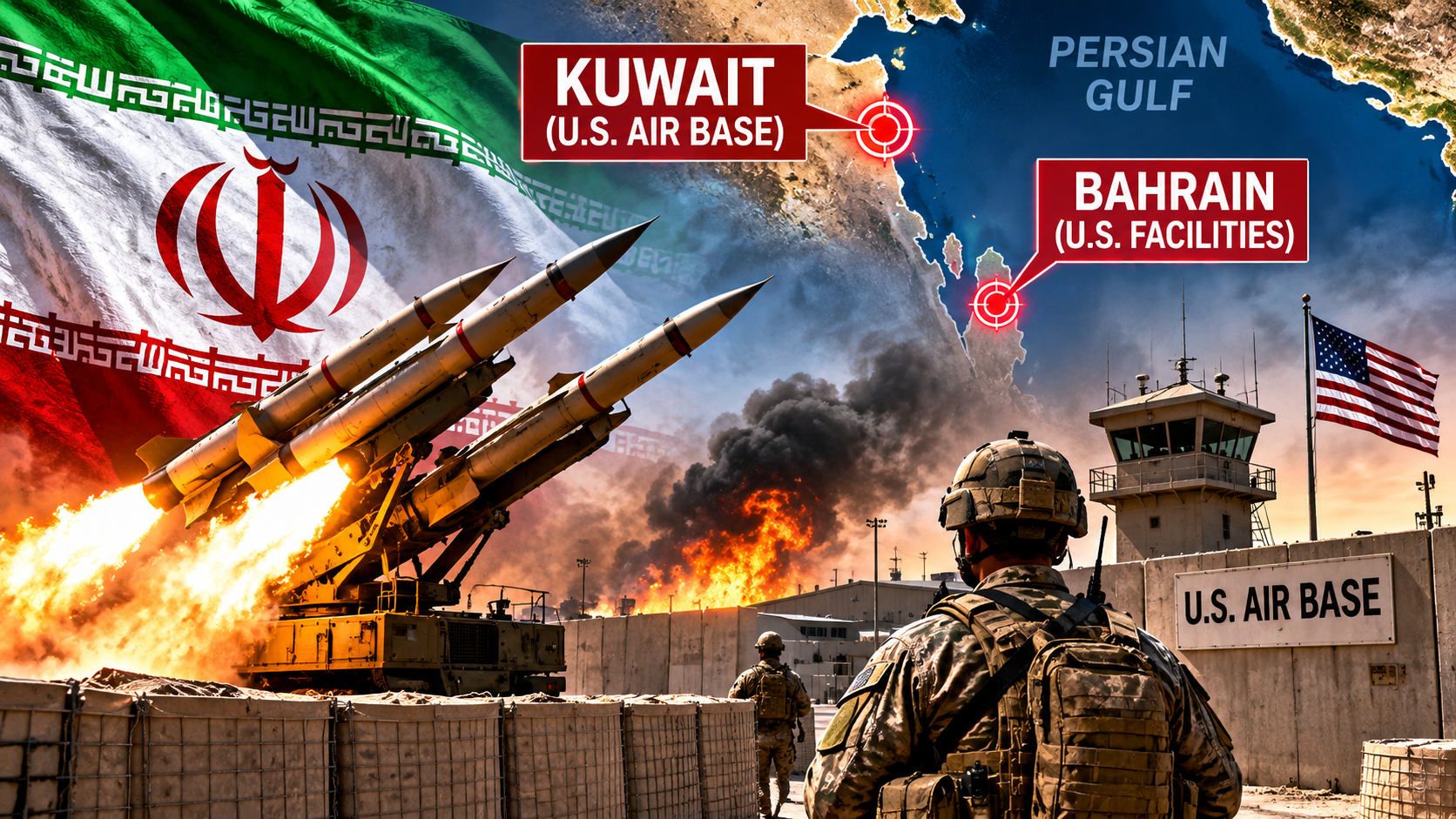
Posted by: MurrayReportIran has reportedly expanded its military operations across the Persian Gulf, targeting an American air base in Kuwait and launching multiple attacks against facilities in Bahrain, raising concerns that the ongoing conflict between Washington and Tehran could escalate into a broader regional confrontation.
The attacks early Wednesday followed a series of retaliatory military strikes between U.S. and Iranian forces, including an American fighter jet attack on an Iranian Revolutionary Guard missile launch site on Qeshm Island near the strategically important Strait of Hormuz.
According to the Associated Press, the latest escalation comes after approximately two months without similar Iranian attacks, signaling renewed tensions in a conflict that has already destabilized the region.
Iran Targets American Military Installations in Kuwait and Bahrain
Iran's latest operations reportedly included an attack targeting a U.S. air base in Kuwait, alongside multiple strikes against facilities in Bahrain.
Bahrain, a small island nation in the Persian Gulf, hosts the headquarters of the U.S. Navy's Fifth Fleet, making it a critical location for American military operations throughout the Middle East.
Iranian forces have repeatedly targeted American facilities in Bahrain in recent days, including attacks reported on Friday, Sunday and Tuesday.
Tehran has characterized its operations as retaliation for American military activity, including U.S. drone surveillance missions and an alleged strike against Iranian communications infrastructure.
The latest attacks further increase the possibility of direct military confrontation between American and Iranian forces stationed throughout the region.
The U.S. military had not immediately responded to requests for comment concerning Wednesday's reported strikes, according to the AP account.
U.S. Fighter Jet Strikes Iranian Missile Site in Strait of Hormuz
The latest escalation followed an American fighter jet strike Tuesday targeting a Revolutionary Guard missile launch facility on Qeshm Island.
The island occupies a strategically sensitive position near the Strait of Hormuz, one of the world's most important maritime passages for international energy shipments.
American officials reportedly launched the strike in response to an earlier Iranian attack against a U.S. radar installation in Bahrain.
Iran subsequently expanded its operations against American-linked military facilities in neighboring Gulf countries.
The continuing exchange of attacks demonstrates the difficulty of containing hostilities as both countries respond militarily to perceived threats against their personnel and infrastructure.
U.S. Naval Blockade Increases Economic Pressure on Tehran
Iran is also facing mounting economic pressure from an ongoing American naval blockade.
The restrictions have affected Iran's economy and its ability to conduct maritime trade, while U.S. military escorts have helped restore the movement of oil tankers through the Strait of Hormuz.
The waterway is particularly important because a significant portion of internationally traded petroleum passes through the narrow shipping corridor.
Security analysts believe that continued economic pressure and military restrictions could be contributing to Tehran's decision to intensify attacks against American facilities.
Hamidreza Azizi, a senior Iran analyst at the International Crisis Group, warned that repeated military incidents across multiple locations increase the possibility of unintended escalation.
His assessment emphasized that even when neither Washington nor Tehran seeks a wider confrontation, successive retaliatory attacks can create circumstances in which a military incident triggers a much larger conflict.
President Trump Sends Third Aircraft Carrier Despite Downplaying New Strikes
President Donald Trump has delivered mixed signals concerning Washington's next steps in the confrontation with Iran.
While the president has indicated that additional American strikes are highly unlikely, the United States has simultaneously strengthened its military presence in the Middle East.
The deployment of a third American aircraft carrier and thousands of additional troops represents a significant reinforcement of U.S. military capabilities in the region.
The increased deployments provide Washington with additional military options while also signaling its commitment to protecting American installations, personnel and regional allies.
However, the continued movement of military forces into the region comes amid growing concern that another exchange of retaliatory strikes could further expand the conflict.
Diplomatic Negotiations Stall as Regional Tensions Rise
The renewed attacks are complicating efforts to negotiate a diplomatic resolution to the conflict, which has continued for nearly nine months.
Qatar has intensified its mediation efforts, but negotiations between the opposing sides have reportedly made little progress.
The latest military exchanges could further undermine diplomatic efforts as both Washington and Tehran attempt to maintain pressure on one another.
The situation also presents increasing security concerns for neighboring Gulf nations that host American military installations.
Kuwait and Bahrain have now become focal points in the latest escalation, highlighting the potential exposure of U.S. military facilities throughout the region.
Fears Grow Over Wider Middle East War
The growing number of military confrontations across the Persian Gulf has raised concerns about whether the current cycle of retaliation can be contained.
American military installations, Iranian missile facilities and strategically important maritime routes have all become flashpoints in the continuing conflict.
The combination of economic sanctions, naval restrictions, expanded American military deployments and Iranian retaliatory strikes has created an increasingly volatile security environment.
Despite ongoing diplomatic efforts, the latest attacks illustrate how rapidly tensions can intensify when military forces repeatedly exchange strikes.
With Iran now targeting American-linked facilities in Kuwait and Bahrain, the central question is whether Washington and Tehran can prevent further escalation or whether another round of retaliation will deepen the regional conflict.
Source Attribution: Associated Press (AP)