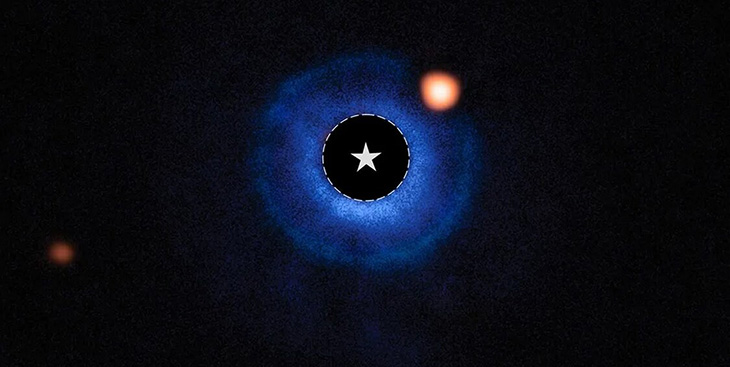
James Webb Telescope Reveals Potential New Planet
R Murray MurrayReport: NASA's James Webb Space Telescope has demonstrated an extraordinary ability to detect planets orbiting distant stars by blocking overwhelming starlight, potentially revealing one of the lightest exoplanets ever directly imaged.
The discovery, announced in June 2025, involves a possible Saturn-mass planet orbiting TWA 7, a young red dwarf star approximately 111 light-years from Earth.
Scientists believe the object, designated TWA 7 b, could represent Webb's first discovery of a previously unknown planet through direct imaging.
NASA Science
How Webb Blocks Starlight to Reveal Hidden Planets
Detecting planets around distant stars is extremely difficult because stars emit far more light than their orbiting companions.
To overcome this challenge, Webb uses a specialized instrument called a coronagraph, which blocks much of a star's glare, allowing astronomers to observe faint objects nearby.
Using Webb's Mid-Infrared Instrument (MIRI), researchers detected a faint infrared source within a disk of dust surrounding TWA 7.
The object sits approximately 50 times farther from its star than Earth is from the Sun.
Its estimated mass is comparable to Saturn's, while its temperature is approximately 120 degrees Fahrenheit.
Mysterious Object Found Inside Planetary Dust Ring
The potential planet occupies a gap within one of three dust rings surrounding TWA 7.
Astronomers believe developing planets can create these gaps through gravitational interactions with nearby material.
Lead researcher Anne-Marie Lagrange said the candidate appeared where theoretical models predicted a planet of that mass could exist.
Its brightness, location and infrared characteristics closely match expectations for a young exoplanet.
However, scientists acknowledge a small possibility that the detected light originates from a distant background galaxy.
Additional observations are needed to confirm the object's identity.
NASA Science
Discovery Could Transform the Search for Alien Worlds
Astronomers have directly photographed exoplanets before, but Webb's findings could establish a new benchmark for detecting smaller, fainter worlds.
Most known exoplanets were discovered indirectly by measuring changes in starlight or gravitational effects on their host stars.
Direct imaging allows researchers to examine planetary systems and potentially study the characteristics of individual worlds.
If confirmed, TWA 7 b could also provide direct evidence of a planet shaping the dusty disk surrounding its star.
The discovery represents another major step toward understanding how planetary systems form and identifying previously hidden worlds beyond our solar system.
Source Attribution: NASA, European Space Agency, Nature — research published June 25, 2025.